
Lennox Package Unit Frozen Solid: We Brazed the Coil on the Roof
A punctured copper tube on a commercial rooftop unit in Los Angeles, repaired on-site instead of a full coil replacement.
In this guide
The call: a frozen package unit on a sports facility roof
The call came from a busy sports facility in Los Angeles: the commercial package unit on the roof had stopped cooling. Up on the roof, the ice told most of the story. The evaporator was frozen solid, and refrigerant was leaking out near the coil.
A frozen coil is a symptom, not the disease. Two things drive it. A low refrigerant charge drops the pressure inside the coil and lets it run colder than it was designed to. Weak airflow leaves the coil pulling moisture out of the return air faster than it can shed it. Either way the ice builds layer by layer until the air stops moving. We found trouble on both sides of that here, though which one started the ice is not something the roof was going to tell us.
The puncture
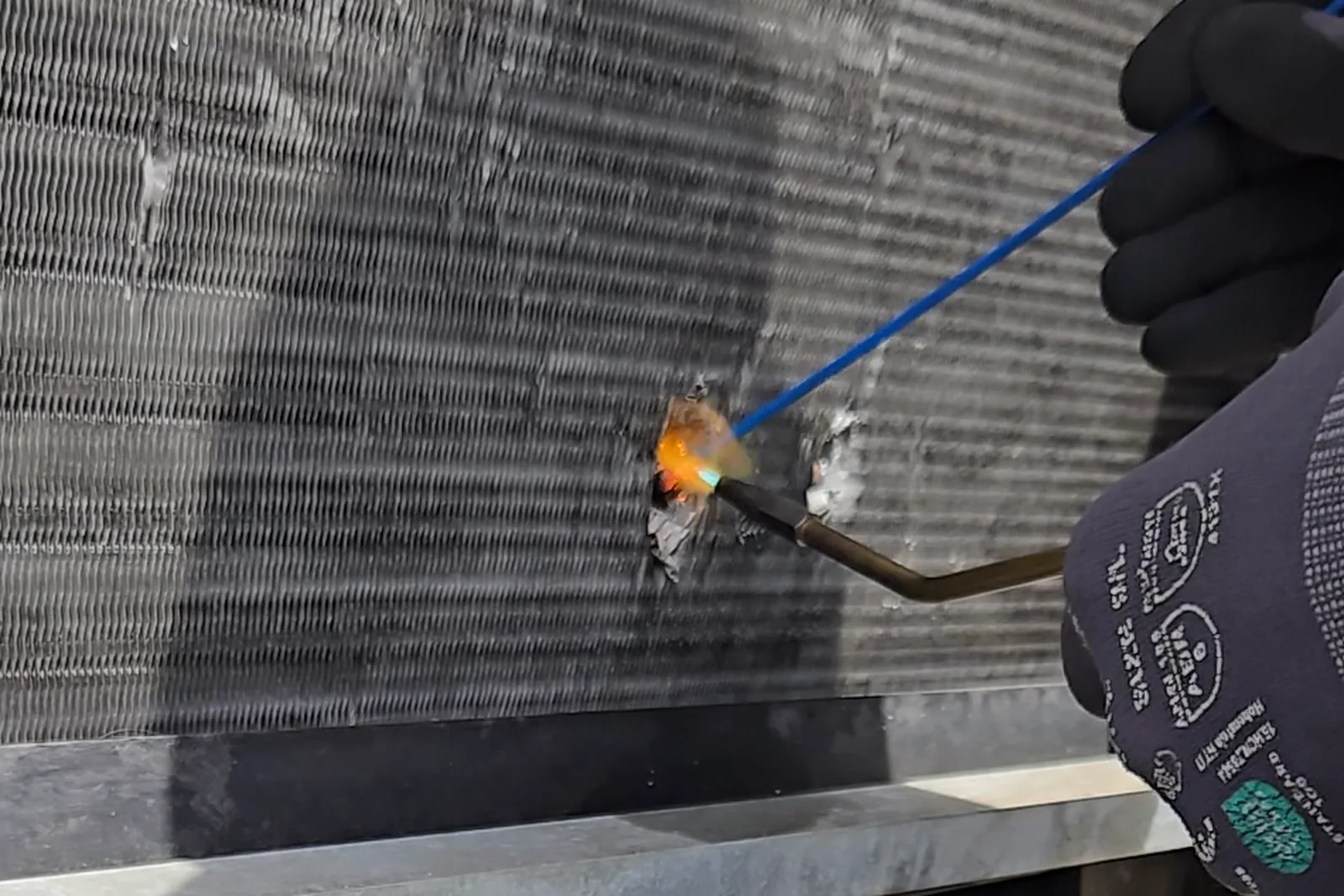
One of the copper tubes on the evaporator had a puncture in it. My best guess: at some point somebody tried to chip the ice off and went right through the tube. Copper is soft, ice is hard, and a screwdriver doesn’t know the difference. I can’t prove that’s how it happened. I can prove where the leak was, and that’s the part that matters for the repair. It’s worth following the theory through, though: if the tube was opened while somebody was clearing ice, then the leak came after the freeze, not before it.
Why this coil could be saved
This is a Lennox unit with an old-school copper evaporator, and that one detail decided the whole job. Copper takes a braze. Newer aluminum and microchannel coils usually don’t repair well, so a puncture there often means replacing the entire coil. On a commercial package unit that’s a serious bill, a long wait for parts, and days of downtime for the building. Here we could fix it the same day, on the roof.
Finding the exact spot
I put a little nitrogen into the system so the leak would show itself, found the puncture, and then kept checking to see if there was another leak hiding anywhere else. There wasn’t. One tube, one hole.
Brazing and the pressure test
With the spot confirmed, I brazed the tube right on the unit. Then came the nitrogen pressure test. The pressure held. It was actually climbing a little, which sounds alarming until you remember the physics: it was brutally hot on that roof, and nitrogen pressure rises with temperature. Falling pressure means a leak. Rising pressure on a hot afternoon means the sun is doing its job.
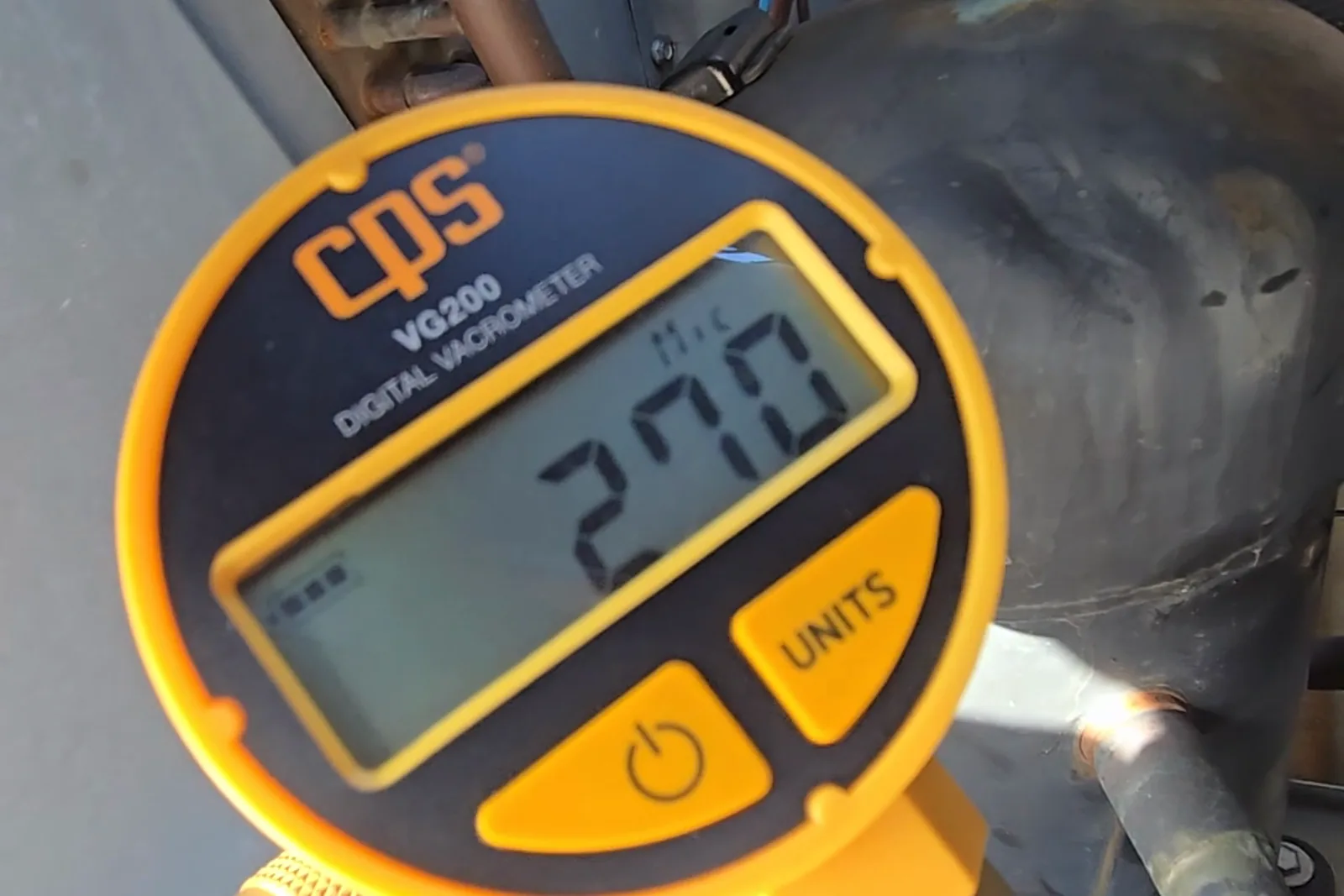
270 microns
The real proof came next. We pulled a deep vacuum on the system and watched the gauge. Ten, fifteen minutes in, it was still sitting at 270 microns. A reading that low, holding that long, means the system is tight and dry, with nothing left inside to freeze up a metering device or turn into acid later on. This is the number I trust more than any bubble test.
The stop-leak question
I did think about adding a stop-leak product as cheap insurance. Then I looked at the gauges again. The vacuum held. The pressure held. Putting an additive into a system that just proved it’s tight didn’t make sense, so we skipped it. If a system needs stop-leak to survive, it has a leak that needs finding, not hiding.
Recharging to the nameplate
The nameplate on this Lennox lists a factory R-410A charge of 15 pounds, 3 ounces. On a system that has been emptied and evacuated, that label is the reference every recharge gets weighed against, which is why you read it before you touch the gauges. With the vacuum holding, we brought the system back up on refrigerant.
One more thing: the belt
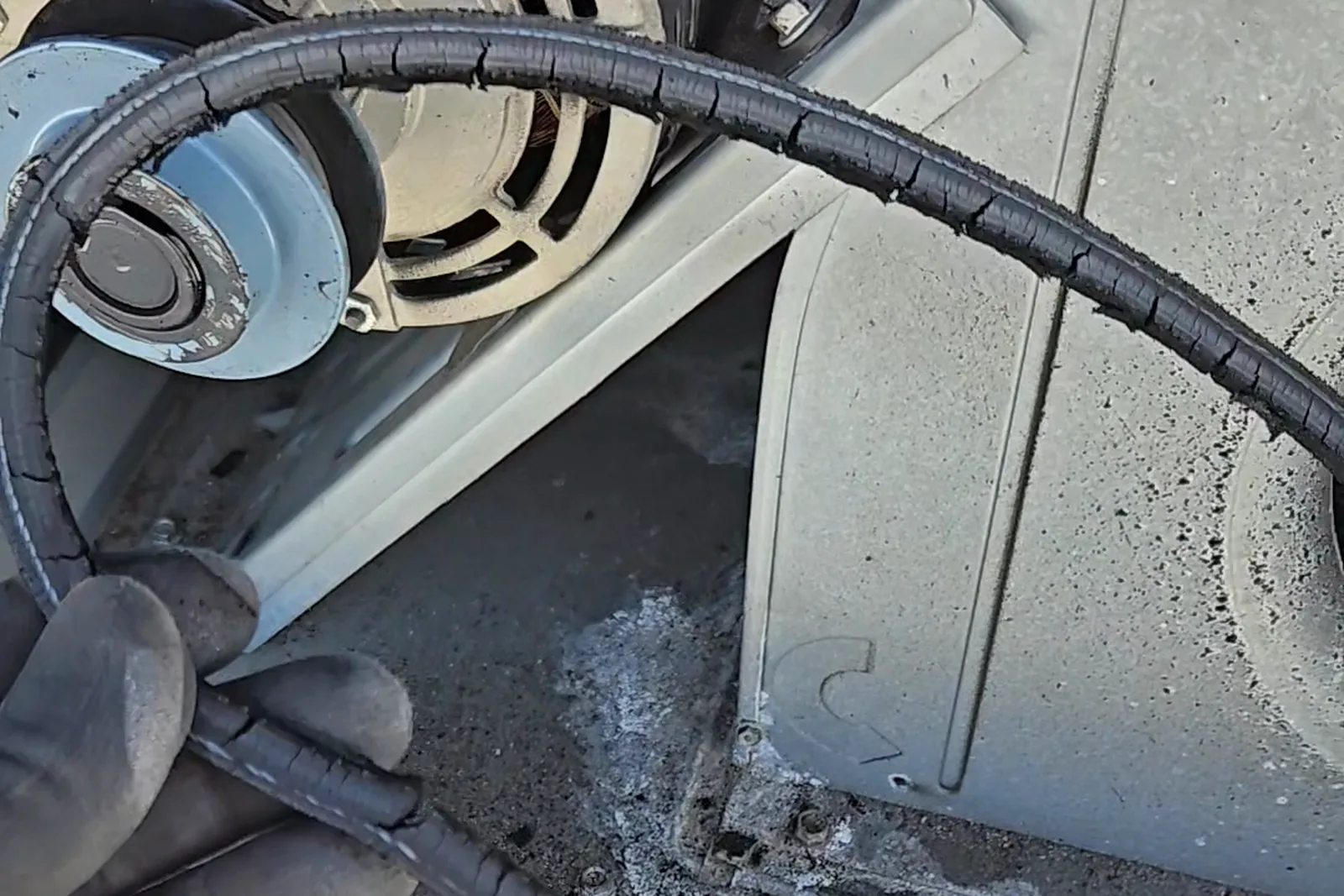
Before we buttoned the unit up, I pulled the blower belt. It was worn out completely, the kind of belt that strands a building in the middle of a heat wave. A new belt went on and I set the tension. A weak belt also means weak airflow, and weak airflow is one more way a coil ends up frozen, so this wasn’t a side quest.
The numbers
Return air 83.8°F, supply air 60.2°F. That’s a 23.6°F split, and the unit was cooling properly when we left it. The unit went back to work, and the coil that somebody almost turned into a replacement quote is still on the roof doing its job.
Commercial HVAC repair on Los Angeles rooftops
Epic Star Inc works on rooftop package units, mini splits, and commercial refrigeration across the Westside, Hollywood and the San Fernando Valley. CA BEAR registered (#A 50636). We quote a flat rate upfront, and the $85 service call is credited toward the repair. If your unit iced up or stopped cooling, call before somebody takes a screwdriver to the ice.
FAQ
Can a punctured evaporator coil be repaired instead of replaced?
If the coil is copper, usually yes: we find the leak with nitrogen, braze it, then prove the repair with a pressure test and a deep vacuum. Aluminum and microchannel coils are a different story and often have to be replaced.
Why does an AC coil freeze up?
The two usual causes are a low refrigerant charge and weak airflow from a dirty filter or a worn blower belt. On this unit we found both: refrigerant leaking out of the evaporator, and a blower belt at the end of its life.
Should I chip the ice off a frozen coil?
No. Shut the cooling off and let it thaw, or run the fan only. The tubing under the ice is thin copper or aluminum, and one slip can turn a maintenance visit into a coil repair.
What does a 270-micron vacuum reading mean?
It's a deep-vacuum measurement. A system that reaches that level and holds it for 10 to 15 minutes is tight and dry, which is exactly what you want to see after a leak repair.
Do you service commercial package units in Los Angeles?
Yes. We repair rooftop package units for gyms, restaurants and other commercial buildings across the Westside, Hollywood and the San Fernando Valley. The $85 service call is credited toward the repair.
Got an appliance that needs fixing? We cover LA and the Valley.
Call (213) 205-2055 or text a photo of your appliance.