
Old R22 AC With a Leaking Condenser Coil — Why You Can't Just Replace the Outdoor Unit
A completely empty system, a leak we traced to the condenser coil, and the honest verdict on why an old R22 unit can't be band-aided or half-replaced.
In this guide
When an air conditioner won’t turn on and the system is completely empty, the question isn’t “how much refrigerant does it need” — it’s “where did it all go, and is this system worth saving?” This was an older AC in Sherman Oaks running on R22, the refrigerant that’s been phased out of U.S. production since 2020. The customer’s complaint was simple: the outdoor condenser unit wouldn’t kick on. What we found turned a service call into an honest repair-or-replace conversation. (There’s a short clip of the leak search above.)
”The condenser won’t turn on” — and why
The homeowner reported the outdoor condenser wasn’t starting. When we checked the system, it was completely empty — no refrigerant left at all. That actually explains the no-start: most condensing units have a low-pressure safety switch that won’t let the compressor run when there’s no charge, so the unit protects itself by refusing to start. The dead outdoor unit wasn’t the disease — it was the symptom. The real question was where an entire system’s worth of refrigerant had gone.
Finding the leak: nitrogen and a leak detector
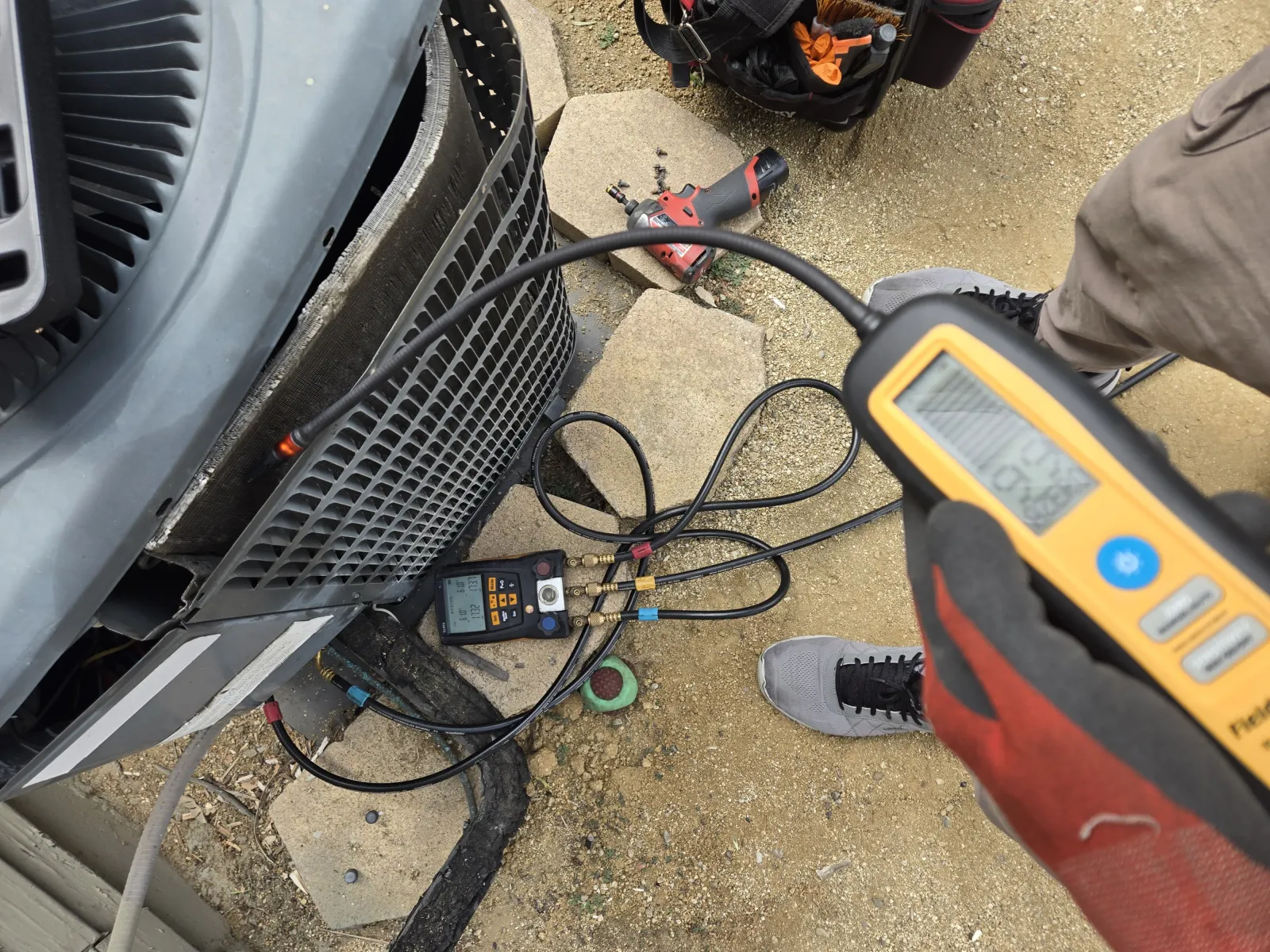
A system that’s bone dry has no pressure in it, so you can’t just wave a detector at it and hope. You have to put it under pressure on purpose. We introduced a small amount of refrigerant as a tracer, then brought the system up with a strong charge of dry nitrogen to a high test pressure. With the system holding that pressure, we swept it with an electronic leak detector — and it picked up the leak almost immediately, right in the condenser coil.
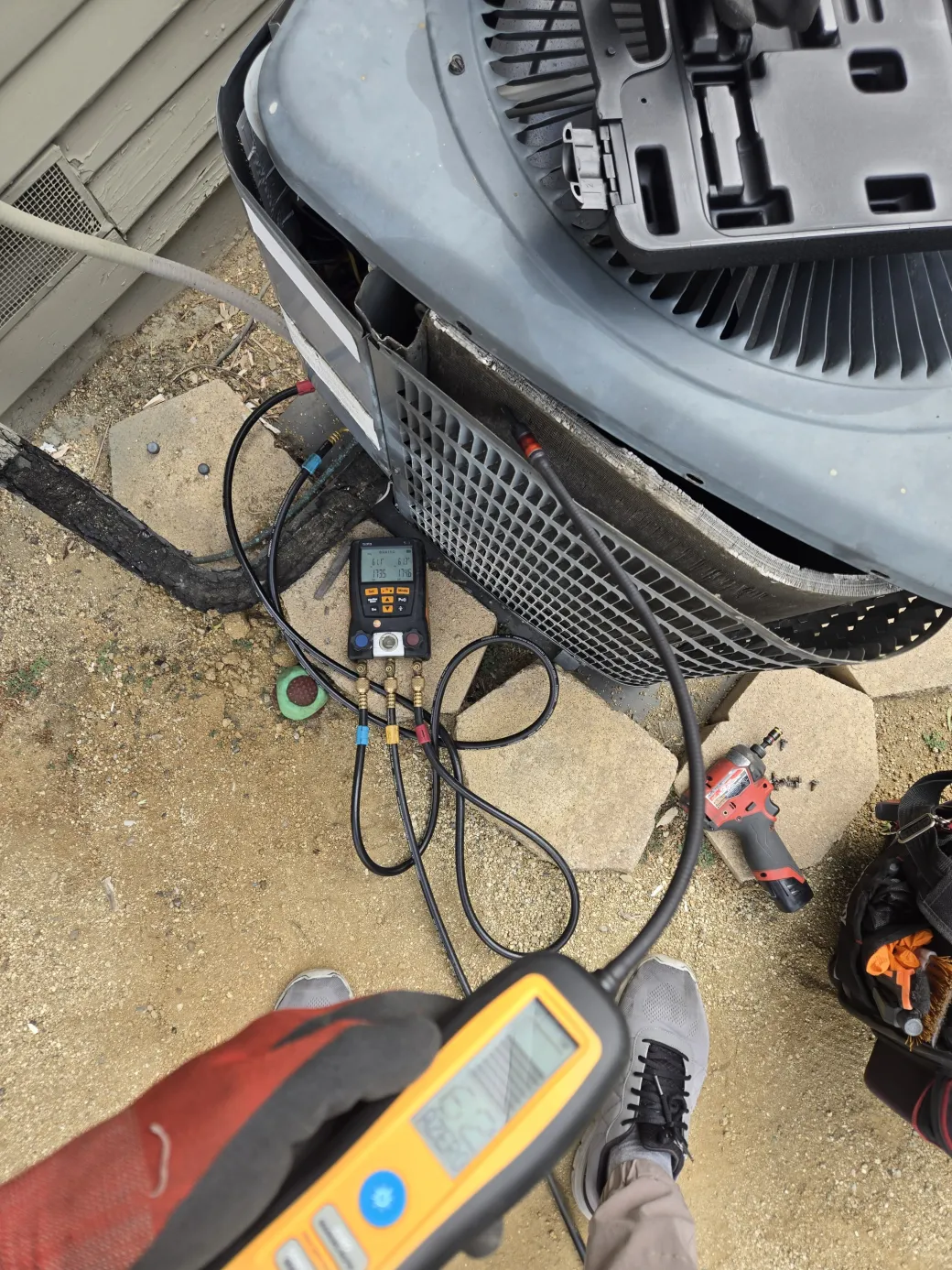
That’s the honest way to find a leak: prove where it is, on the gauge and the detector, instead of guessing and “topping off.” You can watch that part of the job in the clip on our AC tune-up and diagnosis page.
Why this condenser coil can’t be patched
A leak in a condenser coil is rarely a single, fixable spot. These coils fail through pinhole corrosion — tiny perforations that tend to show up in more than one place at once. Brazing one hole on a thin, already-corroded coil just moves the problem a few inches down the tubing; the next pinhole lets go a little while later. On a coil that has already failed this way, a “repair” doesn’t hold, and we won’t sell a fix we don’t believe in. This coil was done.
Why you can’t just replace the outdoor unit
Here’s where R22 changes everything. The instinct is reasonable — the leak is outside, so replace the outdoor condenser and keep the rest. But three things make that impossible on a system this old:
- R22 is phased out. It hasn’t been produced or imported in the U.S. since 2020. Whatever’s left is reclaimed stock — limited and expensive. Recharging a leaking R22 system means buying scarce, costly refrigerant just to pour it into a known leak.
- New outdoor units don’t run R22. Today’s condensers are built for lower-GWP refrigerants like R-32 and R-454B. You can’t put a modern R-32 or R-454B condenser on an old R22 indoor coil — they’re engineered for different refrigerants, different operating pressures, and different metering.
- The system has to be matched. An air conditioner is a matched set: the outdoor condenser and the indoor evaporator coil are designed and certified to work together (an AHRI-matched system). Change the outdoor unit to a new refrigerant and the indoor evaporator coil has to change to match it. Bolting a new condenser onto an old, mismatched coil kills efficiency, voids the warranty, and usually won’t cool properly at all.
So “just swap the outdoor unit” isn’t a real option here. The moment the refrigerant changes, the indoor coil has to change with it — the new system has to be comparable, end to end.
The honest verdict
On this job there was no shortcut. The condenser coil leaked and can’t be reliably repaired; the refrigerant it runs on is obsolete; and you can’t half-replace your way around that. The real fix is a matched new system — a new condenser and a new indoor evaporator coil on a current refrigerant, sized for the home. We’d rather tell you that on day one than sell you a top-off that leaks back out before the next heat wave.
We don’t put a price on a repair we don’t believe in. The leak search runs on our $85 diagnostic (credited toward the work if you move forward), and a matched system replacement is quoted per home after we size it properly. If you want a second opinion before you commit, book an honest AC diagnosis, where the 32-second clip of this leak search plays — and if you’re weighing a full system, our HVAC service covers the matched replacement too. When the math is close, our repair-vs-replace guide walks through how we decide.
Old AC in the Valley
Sherman Oaks and the wider San Fernando Valley are full of older homes with R22 systems that have been limping along for years. Every summer the heat finds the weak spot, and a coil that’s been slowly corroding finally lets go. If your AC is more than about 12–15 years old, runs on R22, and won’t hold a charge, you’re likely looking at the same decision this homeowner faced. The upside: a properly matched modern system runs quieter, costs less to run, and uses a refrigerant you can actually still buy.
Epic Star Inc has completed 1,266+ appliance and HVAC repairs across Westside LA since 2024. We’re California BEAR registered (#A 50636), EPA Section 608 Universal certified, carry $1M general liability insurance, and back our labor with a 30-day warranty. Same-day appointments are subject to booking availability, and your $85 service call is credited toward the repair when service proceeds. We work in English and Spanish.
Call (213) 205-2055
FAQ
Can I just add refrigerant to my R22 AC if it's leaking?
No. Refrigerant runs in a sealed loop, so if your AC is low or empty it's leaking — and adding more just leaks back out. With R22 that's an expensive mistake: it hasn't been produced in the U.S. since 2020, so the only R22 left is costly reclaimed stock. The right move is to find and fix the leak, or replace the system — not keep feeding a known leak.
Why can't I replace only the outdoor AC unit?
Because new outdoor units don't run on R22. Today's condensers are built for lower-GWP refrigerants like R-32 and R-454B, which use different operating pressures and metering than R22. A modern condenser can't run on your old R22 indoor coil. An AC is a matched set, so when the refrigerant type changes, the indoor evaporator coil has to be replaced to match the new outdoor unit.
Is R22 refrigerant still available?
Production and import of R22 ended in the U.S. in 2020. The only R22 left is recovered and reclaimed refrigerant, which is limited and expensive. That's one more reason putting it back into a leaking system rarely makes financial sense — you're buying scarce refrigerant to pour into a known leak.
What refrigerant do new AC systems use?
Newer systems use lower-GWP refrigerants, mainly R-32 and R-454B, which are replacing older R22 and R-410A. They aren't interchangeable with R22 — the system, coil, and metering are all engineered for the specific refrigerant, which is why an old R22 unit can't simply be recharged with a new one.
Can a leaking condenser coil be repaired?
Usually not reliably. Condenser coils tend to fail through pinhole corrosion — tiny perforations, often in several spots at once. Brazing one hole on a thin, already-corroded coil just moves the problem a few inches down the tubing, and the next leak shows up soon after. On a coil that has already failed, replacement is the lasting fix, not a patch.
Does my evaporator coil really need to be replaced with the outdoor unit?
Yes, when you change refrigerant type. The outdoor condenser and indoor evaporator coil are a matched set (AHRI-matched) engineered to work together. A new R-32 or R-454B condenser needs a matching indoor coil to run correctly, hit its rated efficiency, and keep its warranty. Pairing a new condenser with an old, mismatched R22 coil usually doesn't work right and voids the warranty.
Got an appliance that needs fixing? We cover LA and the Valley.
Call (213) 205-2055 or text a photo of your appliance.