
The Walk-In Cooler That Froze Solid Twice
The display said 34 degrees, the evaporator was one block of ice, and the real fault was a temperature setting — how a bakery's walk-in iced up again six months after a proper defrost.
In this guide
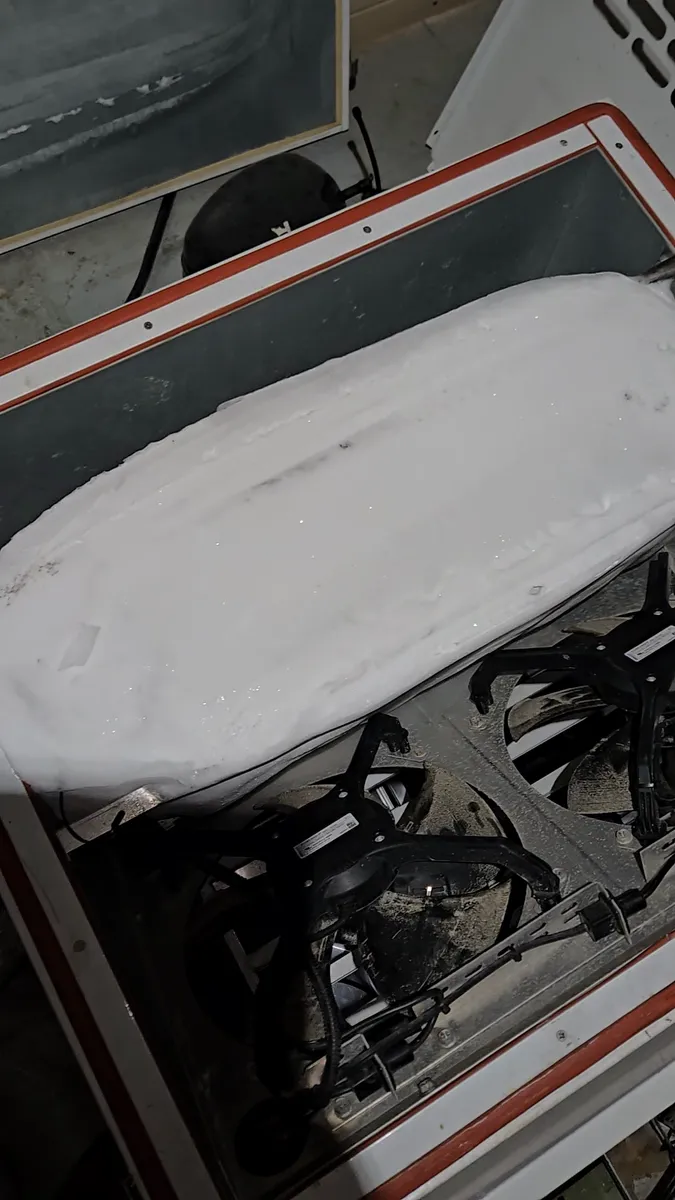
The evaporator in this bakery’s walk-in cooler had disappeared under a continuous slab of ice — no airflow, the coil frozen into one solid block. And this was the second time. About six months earlier the owner had paid another company for a defrost that was never actually performed; we thawed the unit properly back then and dialed in the temperature settings. Now the ice was back, and the job was to figure out why it kept returning.
The display said 34 degrees. The coil ran much colder.
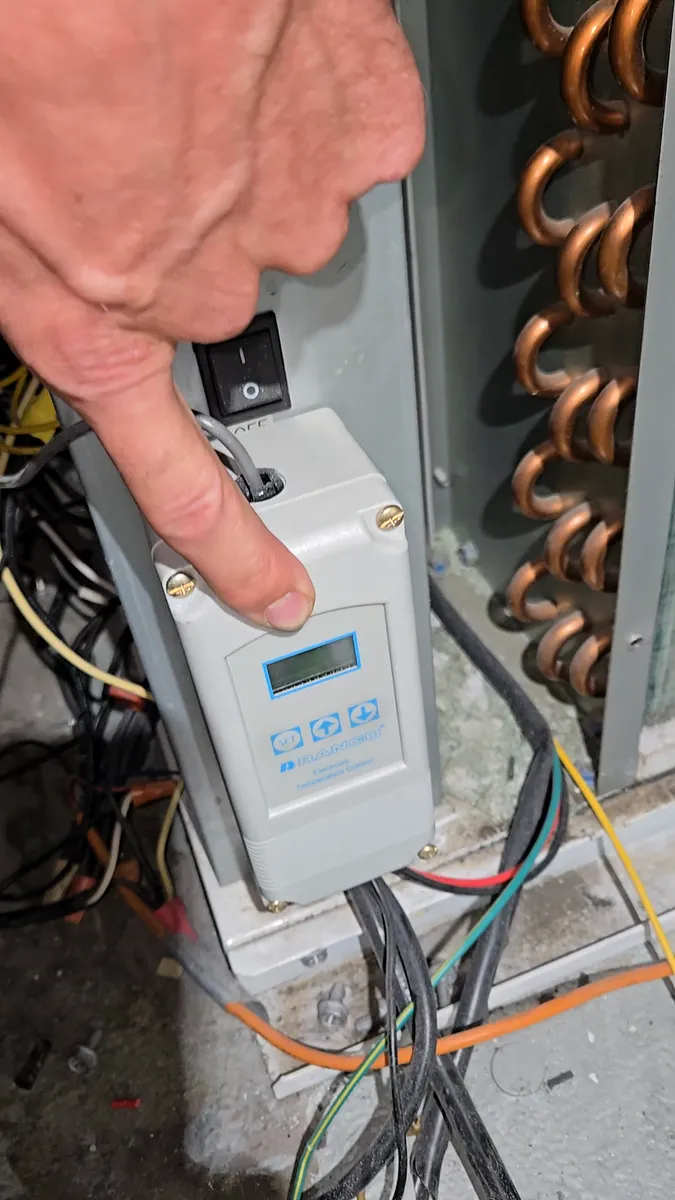
The controller on this walk-in read about 34°F, which sounds like a healthy number for a cooler. The catch is where that number comes from. The temperature sensor hangs low in the box, and down there it reads close to room temperature — the number on the display is not the coil temperature. Up at the evaporator, the unit runs much colder than what the screen shows. And the setpoint we found was far too low. Dialed down that far, the coil sits below freezing and never recovers: frost has no chance to melt, so it keeps growing.
No defrost cycle, and no way to run one
This unit has no defrost cycle at all — there is no way to run one. Most refrigeration clears its coil on a schedule, melting frost off before it builds. Here, nothing does that job, so the temperature setting is what keeps the coil clear. Set too low, the coil never climbs above freezing, and ice accumulates until the evaporator is one solid block with no air moving through it. Ice on the evaporator chokes cooling in a walk-in the same way it does in a home refrigerator that stops cooling — the cold is there, but the airflow that carries it is gone.
The TXV was iced over too. The valve was fine.
Under all that ice, the TXV — the valve that meters refrigerant into the evaporator — had frozen over as well. It would have been easy to blame the valve and quote a replacement. The valve didn’t need one. The TXV on this unit is fine; it was iced over because everything around it was iced over. The fault was the temperature setting, and no new part would have fixed that.
What most likely wiped the settings
The most likely explanation: a power outage reset the controller and wiped everything we had dialed in. It is a quiet failure — nothing looks broken afterward, the unit keeps running, the display shows a normal number, and the coil quietly ices up. If your walk-in has been through an outage, checking the controller settings takes a minute and can save the coil.
Steam takes the ice off without bending a fin
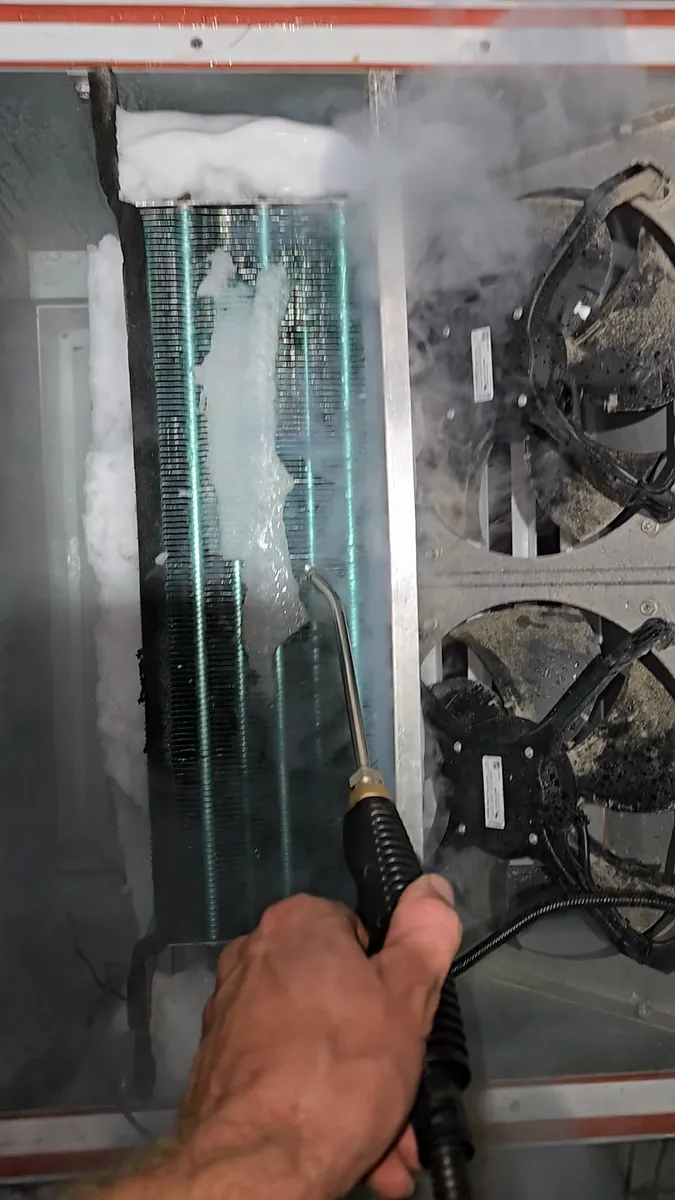
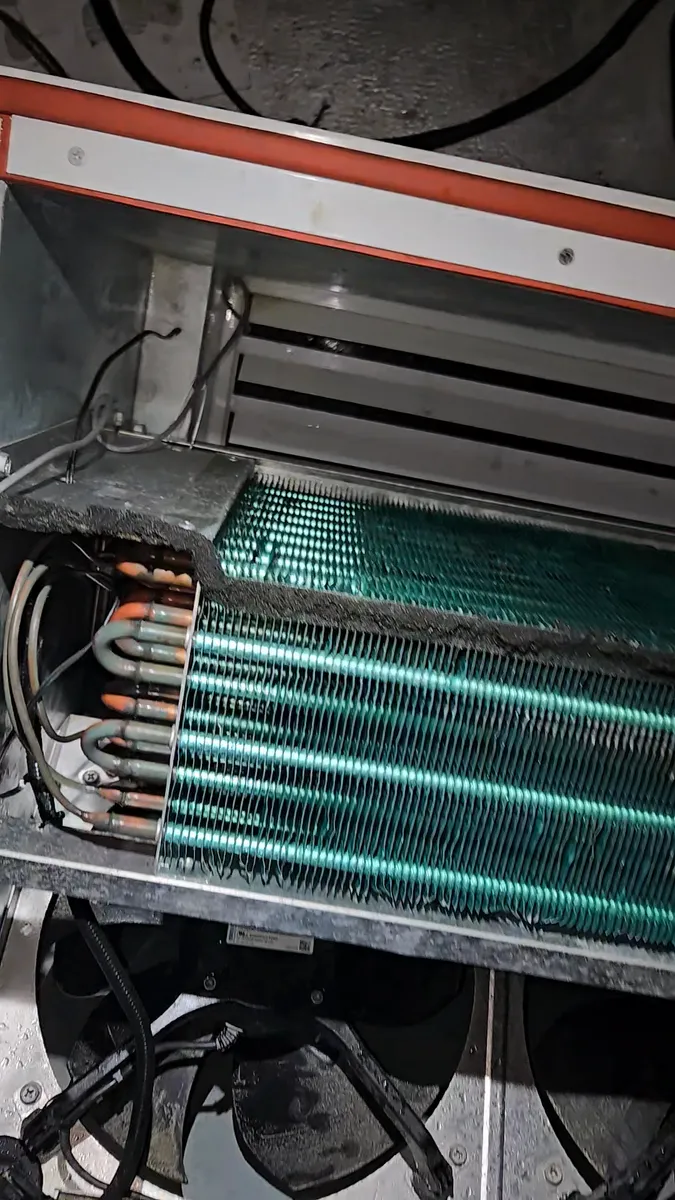
The repair started at the switch: shut the unit down. Then the coil was thawed with steam. Steam melts the ice off the fins without bending a single one of them, and when the thaw was done the result was easy to verify — a clean, ice-free coil with full airflow through it. This unit runs on R-404A, and its condensing unit sits up top of the box, so that got checked too. Then the step that decides whether the repair holds: the correct settings went back into the controller, so the coil stays clear this time.
If you paid for a defrost, ask to see the coil
Part of this story bears repeating: six months ago, another company charged this owner for a defrost and never did the work. There is a simple way to protect yourself, because a defrost is verifiable. Ask to see the evaporator when the job is done — bare fins, no ice, and air moving through the coil are the whole point of the service. And on a unit with no defrost cycle, the job is not finished until the temperature settings are checked and corrected, because a wrong setpoint will bury the coil in ice again no matter how well the thaw was done.
Walk-in trouble at your bakery, restaurant, or shop
We repair walk-in coolers and commercial refrigeration for bakeries, restaurants, and food businesses across Los Angeles, alongside commercial appliance repair and restaurant equipment repair. If your walk-in is icing up, running warm, or just came through a power outage, we look for the actual cause — we’ve seen jobs where the iced-over part wasn’t the part that failed. Ask about available appointments; timing depends on scheduling and parts. Our work carries 30-day labor and 90-day parts warranties. Call or text (213) 205-2055, or book online.
FAQ
Why does a walk-in cooler freeze solid?
On this bakery's unit the temperature was set far too low, which kept the evaporator coil below freezing with no chance to recover. Frost built into ice, and because the unit has no defrost cycle, nothing ever cleared it — the ice grew until the coil was one solid block with no airflow.
The display says 34°F — how can the coil still freeze?
Because of where the sensor sits. On this walk-in the temperature sensor hangs low in the box and reads close to room temperature, so the display does not show the coil temperature. The coil runs much colder than the displayed number, and with the setpoint dialed too low it stays below freezing.
The TXV was frozen over — does that mean the TXV is bad?
Not on this job. The TXV was iced over because the whole evaporator area was iced over. The valve itself is fine; the fault was the temperature setting. Replacing the valve would have changed nothing.
How do you defrost a walk-in cooler properly?
Shut the unit down and thaw the coil with steam — it melts the ice off the fins without bending a single one. The job ends with a visible result: a clean, ice-free coil with full airflow, and the correct temperature settings entered so the ice doesn't come back.
Can a power outage make a walk-in freeze up?
It can start the chain. On this unit a power outage most likely reset the controller and wiped the settings from the previous visit. The cooler kept running on wrong settings, the coil sat below freezing, and the ice built from there. After any outage it's worth checking the controller settings.
Do you repair walk-in coolers and commercial refrigeration in Los Angeles?
Yes — walk-in coolers and commercial refrigeration for bakeries, restaurants, and food businesses across Los Angeles. Ask about available appointments; timing depends on scheduling and parts. Work includes a 30-day labor and 90-day parts warranty.
Got an appliance that needs fixing? We cover LA and the Valley.
Call (213) 205-2055 or text a photo of your appliance.