
Heater not working? What to check in the first cold weeks in Los Angeles
Symptom by symptom for gas furnaces, gas wall heaters, heat pumps and mini-splits: what you can safely check, what it points to, and when to call.
In this guide
The first cold night of the year is when a heater that sat idle all summer gets tested. Some of what goes wrong is a setting or a switch you can fix yourself. The rest takes a meter and someone who knows the order a heater starts up in.
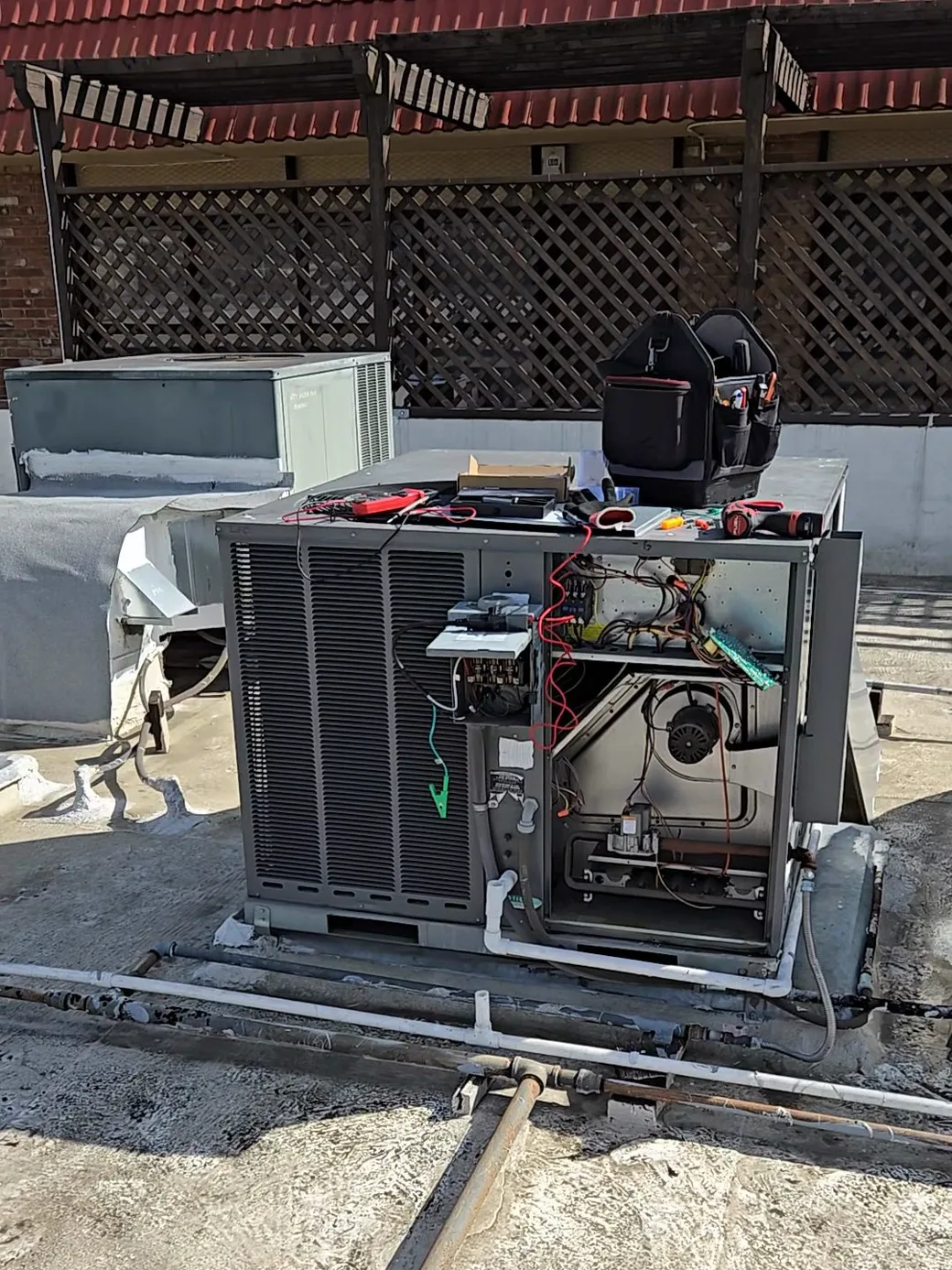
Many LA homes have a package unit on the roof or at ground level, like the rooftop gas pack at the top of this page, with the same kind of gas furnace inside that you’d find in an attic or a closet.
| What you notice | Check first | Call when |
|---|---|---|
| Furnace won’t turn on | Thermostat mode, setpoint and batteries; furnace switch; breaker; lower front panel seated | The status light is dark or blinking a code after those checks |
| Furnace blows cold air | Thermostat fan on AUTO, mode on HEAT | The air stays cold for a whole cycle |
| Burners light, then shut off | Filter, supply registers open, blink code | It keeps cycling or locks itself out |
| Burning or dusty smell | Is it the first start of the season? | The smell stays, comes back or smells electrical |
| Wall heater pilot won’t light or stay lit | The lighting instructions on the heater’s label | It won’t stay lit, or you see soot or a yellow flame |
| Heat pump or mini-split blows cool | HEAT mode, remote batteries, filters, defrost | Cool air with no defrost pause, ice that stays, an error code |
A gas smell skips the table. Go to the safety section first.
Checks that apply to almost every heater
Start at the thermostat. It should be in HEAT mode and set a few degrees above the room temperature. If the screen is blank or faint, put in fresh batteries.
Then pull the filter. A clogged filter starves the furnace of air, and a furnace that can’t move enough air runs hot and shuts itself off. If you can’t see light through it, replace it before the first start of the season.
Next comes power. A gas furnace has its own switch on or near the cabinet, and it looks like an ordinary light switch, so it’s easy to flip off by mistake. Make sure it’s on, and check the furnace’s breaker in your electrical panel.
Check the lower front panel too. Most furnaces have a door switch, a small button that the panel presses in when it’s seated. With the panel off or crooked, that switch cuts the power and the furnace does nothing. If someone changed the filter recently, push the panel back in until it sits flat.
Last, the status light. It sits on the control board, and on most furnaces you can see it through a small window in the lower door. Count the blinks between pauses. There’s often a code chart on a label on the furnace, but you don’t need to decode it: tell us the pattern when you call. If the light is dark, the board has no power, and the switch, the breaker and the door switch come first.
Furnace won’t turn on
Once those checks are done, listen. On a call for heat, a gas furnace runs a fixed sequence. The inducer fan starts, the pressure switch confirms the draft, the igniter glows, the gas valve opens, the flame sensor proves the flame and the blower starts. Where the sounds stop is where the sequence stopped.
Silence and a dark status light mean a power problem: the checks above, or something on the board’s side. If the inducer hums and nothing lights, the furnace stopped at the pressure switch or the igniter. On an attic furnace in Porter Ranch, the igniter itself was good, but the control board wasn’t sending it power, and a new board got the system working normally. A new igniter there would have stayed as cold as the old one. If the inducer never starts turning, there’s no draft for the pressure switch to prove, and the sequence stops before the igniter. On a Goodman package unit in Sherman Oaks, the inducer motor had seized from age, and we replaced the whole inducer assembly, because on that unit the motor, wheel and housing are one part.
Leave the burner compartment closed. The igniter is brittle and gets hot enough to burn you.
Call if the furnace makes its startup sounds but the burners never light, or if the status light keeps blinking the same code.
Furnace runs but blows cold air
Look at the thermostat’s fan setting first. On ON, the blower runs all the time, so between heating cycles it pushes room-temperature air that feels cold at the vent. On AUTO, it runs only when there’s heat to move.
A short burst of cool air at the start of a cycle is normal too. The furnace lets the burners warm the heat exchanger before the blower comes on, and the first air out of the vents is whatever sat in the ducts.
If the air stays cold for a whole cycle, the burners aren’t lighting, or they’re going out while the blower runs. When the igniter glows and the burners still don’t light, the gas valve is one suspect, along with the signal the board sends it. We replace furnace gas valves when the valve is the part that failed. On the furnace in the photo below, a new gas valve brought the heat back.

No air at all is a different symptom. Set the thermostat fan to ON for a minute: if nothing comes out of the vents, the blower isn’t running, and that’s worth mentioning when you call. On a Lennox furnace in Woodland Hills, several companies hadn’t pinned down whether the control board or the variable-speed blower motor had failed. A tester that runs the motor on its own showed the motor was bad, and a new blower motor got the system working normally.
For a heat pump that blows cool air in heat mode, see the heat pump section below.
Burners light, then shut off
Two patterns look alike from the hallway.
In the first, the burners light, run for a few seconds and go out, and the furnace tries again. That furnace can’t prove its flame. The flame sensor is a metal rod that sits in the flame, and the control board reads a tiny current through it. With no current, the board closes the gas valve. A coated or loose sensor rod can cause it, and so can the board. On a Goodman furnace in Burbank, the rod and its wiring checked out, and the control board couldn’t read the flame. After several failed tries, many furnaces lock themselves out for a while and flash a code.
In the second, the furnace heats for a while, the burners shut off with the blower still running, and later it starts again. One cause is the high limit switch, which opens when the furnace runs too hot and closes again once it cools. A clogged filter and closed registers come first. Still, a code tells you what the board thinks it sees, not what failed. A rooftop gas pack at a pharmacy in Encino reported “high limit switch open,” and all three of its limit switches tested closed. The fault was cracked solder joints on the control board, and we reflowed them on the roof.
On your end, replace the filter, open the supply registers and move furniture off them, and count the blinks. Turning the power off and on clears a lockout, but do it only once. If the furnace locks out again, the fault is still there, so leave it off and call.
Call if it keeps cycling with a clean filter.
Burning or dusty smell on the first start
Over the summer, dust settles on the burners and the heat exchanger. The first time the furnace runs in the fall, that dust burns off and you smell it. Open a window, let the furnace run, and the smell should fade. A gas wall heater does the same thing on its first run. A fresh filter before that first start helps.
A smell that hangs on, or comes back every time the heat runs, isn’t dust. Neither is a hot electrical or burning-plastic smell, which can come from wiring or a motor running hot. Turn the furnace off at its switch and call. If you see smoke from the registers, do the same. A smell like rotten eggs is gas, and the safety section below covers it.
A musty smell from a mini-split’s indoor unit is a separate problem. On a Daikin in Granada Hills, the mold was in the drain pan under the coil, and we cleaned the coil, the blower wheel and the pan in place.
Gas wall heater: pilot won’t light or won’t stay lit
A gas wall heater is a heater built into the wall, with a grille in front and a vent that carries the exhaust outside. Many of them have a standing pilot, a small flame that burns all the time and lights the burner when the thermostat calls. Next to the pilot sits a thermocouple. The pilot flame heats it, it makes a small voltage, and that voltage holds the gas valve’s pilot safety open. When the pilot goes out, the thermocouple cools and the valve shuts off the gas.
That’s why the two complaints point to different parts. A pilot that won’t light at all can mean the gas is off at the heater’s valve or at the supply, a clogged pilot opening or a dead spark igniter. A pilot that lights but goes out when you let go, after holding the knob as long as the label says, points to the thermocouple, a pilot flame too weak to heat it, or the gas valve itself.
Follow only the lighting instructions printed on the heater’s label, step by step, including the wait after you turn it off. If it won’t stay lit after that, stop and call. Don’t take the burner cover off, don’t reach into the burner with a lighter, and don’t relight anything if you smell gas.
We repair gas wall heaters, including the pilot, the thermocouple and the gas valve. On a wall heater in Los Feliz whose flame barely burned and wouldn’t adjust, we replaced the gas valve, and the thermocouple too, because it turned out rusty all over and badly burnt. On a wall heater in Santa Monica with the pilot out and nothing lighting, the thermopile was the part we replaced.
Heat pump or mini-split not heating
A heat pump heats your home by pulling heat out of the outdoor air and moving it inside. A ductless mini-split that heats is a heat pump too, so everything here applies to both.
Some pauses are part of normal operation. When the outdoor air is cool and damp, the outdoor coil can run below freezing and collect frost. Every so often the unit reverses for a while to melt it. During that defrost, the outdoor fan stops, you may hear a whoosh and see steam rising off the outdoor unit, and the indoor unit blows little air, or air that isn’t warm. Then the heat comes back on its own. Many mini-splits also hold the indoor fan off for a while when they start in heat mode, so they don’t blow cold air at you while the coil warms up.
Check that the mode is HEAT and not COOL, DRY or FAN, and that the setpoint is above the room temperature. Put fresh batteries in the remote. Slide out the filters behind the indoor unit’s front panel and rinse them if they’re dusty. Outside, clear leaves, covers and anything stacked against the outdoor unit, and check the breaker and the disconnect box next to it.
Call if the unit runs a long time blowing cool air with no defrost pause, if ice keeps building on the outdoor unit and doesn’t clear, or if the indoor unit shows an error code or blinking lights. Write the code down. Also call if the unit neither heats nor cools well. A heat pump with no refrigerant can’t move heat in either direction. In Hollywood, a water-source heat pump in a building closet was empty, and we found the leak with nitrogen, brazed it and recharged the system. In Santa Monica, an empty heat pump was leaking at its suction service valve, and the valve turned out to be fine: someone had opened it too hard. A reversing valve fault can also leave a heat pump stuck cooling when it should heat.
Gas smell, carbon monoxide and venting
If you smell gas, don’t look for the leak. Leave the house without touching light switches or using a phone inside. Once you’re outside, call SoCalGas. Don’t relight a pilot or reset the furnace first. We repair the heater after the gas company has made the home safe, and we don’t work on gas piping.
Any heater that burns gas can make carbon monoxide when combustion or venting goes wrong, and CO has no smell. A working CO alarm is what warns you, so test yours before the first cold night. If it goes off, turn the heater off and call us. We measure the carbon monoxide at the heater, and if it’s leaking, we shut the unit down and offer the repair or a replacement.
A gas wall heater sends its exhaust out through a vent. If that vent is blocked, disconnected or rusted through, the exhaust can spill back into the room. Soot or scorch marks on the grille or on the wall above it are a warning sign. So is a flame that burns yellow and lazy instead of mostly blue. Turn the heater off, leave it off and call. Keep curtains, furniture and anything else that can burn away from the grille all season.
What our published heating and heat pump jobs found
These are the heating and heat pump jobs we’ve written up, with the range each post lists for a repair of that scope. The ranges include parts and labor with the $85 service call credited, and they depend on the model and access. The Encino range covers labor, since no part was replaced.
| Job | Symptom | What it was | Range |
|---|---|---|---|
| Attic furnace, Porter Ranch | Igniter wouldn’t start | Igniter was good; control board replaced | $460–$630 |
| Goodman furnace, Burbank | Not sensing its flame | Sensor and wiring fine; control board replaced | $430–$590 |
| Lennox furnace, Woodland Hills | Fault other companies hadn’t pinned down | Variable-speed blower motor tested bad and replaced | $1,450–$2,000 |
| Rooftop gas pack, Encino | No heat, “high limit switch open” | Switches fine; cracked solder on the board reflowed | $220–$310 |
| Water-source heat pump, Hollywood | System empty | Leak found with nitrogen, brazed, recharged | $690–$950 |
| Heat pump, Santa Monica | Stopped cooling, system empty | Over-tightened suction service valve reseated, vacuum, full charge | $720–$990 |
Our repair cost guide has the rest of the heating and AC rows.
Heating repair across Los Angeles
We repair gas furnaces, gas wall heaters, heat pumps and mini-splits in the San Fernando Valley, Hollywood, the Westside and the Beach Cities. The $85 service call is credited toward the repair if you go ahead, and you get the price after we diagnose the heater on site. Repairs carry a 30-day labor warranty and a 90-day warranty on parts we supply. CA BEAR registered (#A 50636), EPA Section 608 Universal certified, $1M insured. See furnace and heating repair and mini-split service, or call (213) 205-2055. Tell us what kind of heater it is, the brand if you can see it and the blink pattern you counted.
FAQ
Why is my furnace blowing cold air?
Check the thermostat fan setting first. On ON, the blower runs all the time and pushes room-temperature air between heating cycles; on AUTO it runs only when there's heat to move. A short burst of cool air at the start of a cycle is normal too. If the air stays cold for a whole cycle, the burners aren't lighting or aren't staying lit, and that needs a technician: the igniter, the flame sensing, the gas valve and the control board are the places to look.
Is a burning smell normal when I turn the heat on for the first time?
A dusty smell on the first start of the season is normal. Dust settles on the burners and the heat exchanger over the summer and burns off the first time the furnace runs, and the smell fades. A smell that doesn't fade, comes back every time the heat runs, or smells like hot wiring or plastic isn't normal: turn the furnace off at its switch and call. A rotten-egg smell is gas: leave the house and call SoCalGas from outside.
Why does my furnace turn on and then shut off?
If the burners light and go out within seconds, the furnace can't prove its flame. The cause can be the flame sensor rod, its wiring or the control board; on a Goodman furnace in Burbank, the sensor and wiring were fine and the board was the fault. If the furnace heats for a while, shuts the burners off with the blower still running and starts again later, check the filter and the supply registers: a furnace that runs too hot opens its high limit switch. Count the status-light blinks and tell us the pattern.
Why won't the pilot on my gas wall heater stay lit?
The pilot flame heats a thermocouple, and the small voltage it makes holds the gas valve's pilot safety open. If the pilot lights but goes out when you let go, after holding the knob as long as the label says, the thermocouple, a weak pilot flame or the gas valve is the likely cause. Follow only the lighting instructions printed on the heater, and call if it won't stay lit. We repair gas wall heaters, including the pilot, the thermocouple and the gas valve.
Why is my heat pump or mini-split blowing cool air in heat mode?
It may be defrosting. When the outdoor air is cool and damp, frost can build up on the outdoor coil, and the unit reverses for a while to melt it. The outdoor fan stops, you may hear a whoosh and see steam rise off the outdoor unit, and the heat comes back on its own. Call if it blows cool air with no pause and no defrost, if ice keeps building on the outdoor unit, or if the indoor unit shows an error code.
What can I check myself before calling about a heater?
The thermostat mode, setpoint and batteries; the filter; the furnace switch and the breaker; that the furnace's lower front panel is pushed in all the way; and the blink pattern of the status light. On a heat pump or mini-split, also check the remote batteries, the indoor unit's filters and that nothing is blocking the outdoor unit. Don't open the burner compartment, take a wall heater's burner cover off or touch the igniter.
How much does furnace repair cost in Los Angeles?
It depends on the part that failed. On the jobs we've published, a furnace control board typically runs $430–$630 and a variable-speed blower motor $1,450–$2,000, depending on the model and access. Those ranges include parts and labor, with the $85 service call credited. You get the price after we diagnose the heater on site. Call (213) 205-2055.
AC, heater or mini-split acting up? We cover LA and the Valley.
Call (213) 205-2055 or text a photo of the unit and its model sticker.