
A Goodman furnace in Burbank that couldn't sense its flame: the control board was the fault
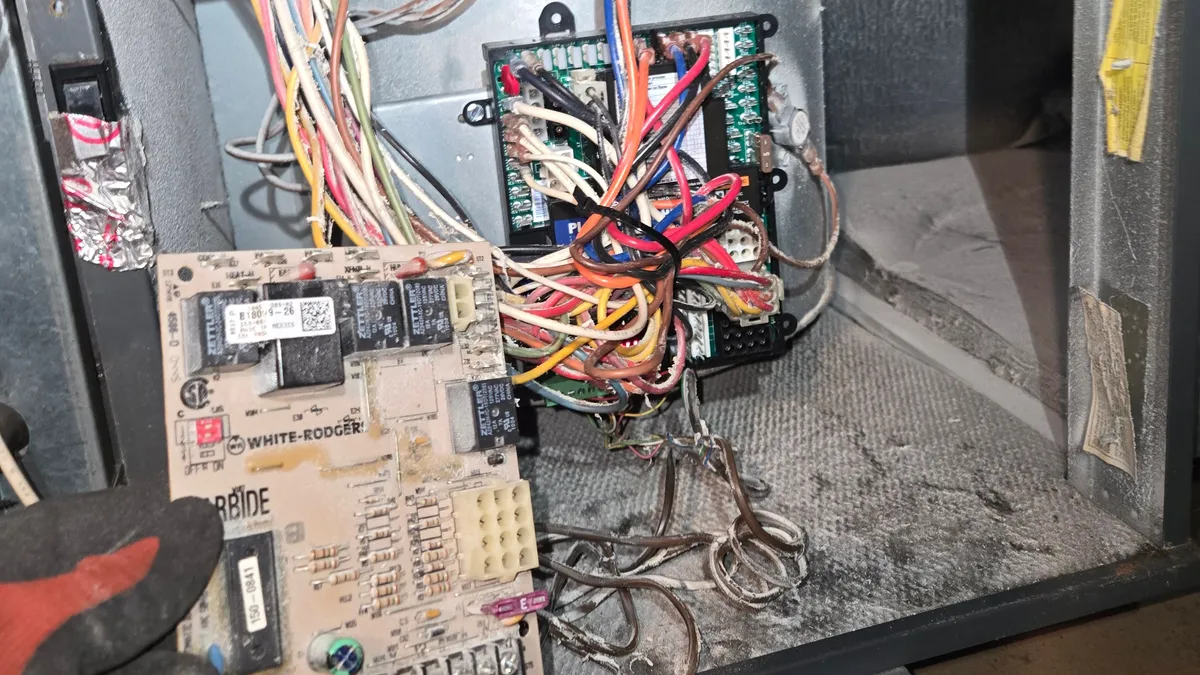
A furnace repair in Burbank. In the photo, the old control board is in my glove and the new one is wired in behind it.
In this guide
A furnace that can’t sense its own flame shuts the gas off even when the burners light. On this Goodman furnace in Burbank, the fault sat on the control board, and a new board was the fix.
The problem: no flame signal
This Goodman wasn’t sensing its flame. In technician’s terms, the flame sensor wasn’t proving flame: the control board wasn’t getting the signal that tells it the burners are lit.
That signal is what keeps the gas valve open. Without it, the board can’t tell a healthy flame from a burner that never lit, so it treats both the same way and shuts the gas off.
What the photo shows
The furnace’s cover is off. In my glove is the old control board. Behind it, the new board is already mounted on the furnace and wired in, with the bundle of colored wires from the furnace running to its terminals.
How does a furnace know its burners are lit?
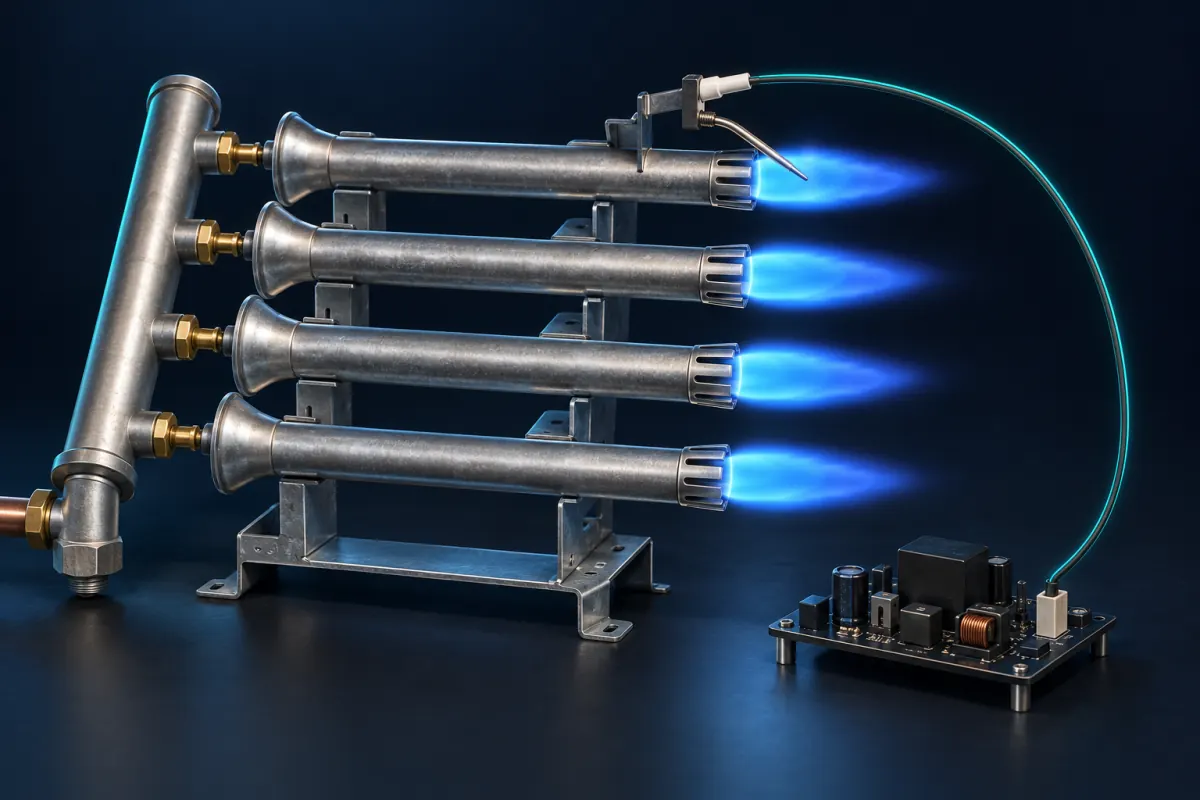
When the thermostat calls for heat, a gas furnace runs a safety sequence. The inducer fan starts and clears the heat exchanger. Then the igniter heats up and the gas valve opens, so the burners light. From that moment the control board has only a few seconds to confirm a flame.
That confirmation comes from the flame sensor, a thin metal rod that sits in the burner flame and is wired back to the board. The board puts a small AC voltage on that rod. A flame conducts a little electricity, and because the grounded burner is much bigger than the rod, current passes through the flame more easily in one direction than in the other. The board reads the result as a tiny direct current, measured in microamps. Technicians call this flame rectification.
If that current is there, the board keeps the gas valve open. If it isn’t, the board closes the valve, usually tries again, and after several failed tries it can lock the furnace out for a while. To someone standing nearby, it looks like a furnace that lights, runs for a few seconds and goes quiet.
Why the board, and not the sensor?
A flame sensor is a very simple part: a metal rod, a ceramic insulator and one wire. It can get coated or come loose, and both are easy to check. Nothing electronic inside it can fail in some hidden way.
So the reasoning is short. If the rod is good, the wiring between the rod and the board is good and the burner is properly grounded, what’s left is the control board, because the circuit that reads the flame current lives on the board. On this Goodman, that’s where it ended: the board was the fault.
The fix: a new control board
We replaced the control board, and the photo at the top shows that stage of the job.
The order matters. A sensor is the simple part, so it gets checked first. The board costs more, so it’s the conclusion once the simple parts check out, not the first guess.
What this job teaches
Flame sensing trouble often gets treated as a cleaning job, and sometimes cleaning is the right answer. When the rod and its wiring are fine, though, cleaning the rod again or swapping in a new one changes nothing. The part that can’t read the flame is on the board, and a furnace like this keeps shutting off until the board is replaced.
A bad board doesn’t automatically mean a new one, either. On a commercial rooftop unit, we found a control board we could repair instead of replace, because cracked solder joints were the cause. And in Porter Ranch, another furnace’s board had stopped powering a good igniter.
What can you check before you call?
Some checks are safe for anyone. Set the thermostat to HEAT and a few degrees above room temperature, and put in fresh batteries if it takes them. Find the furnace switch, which looks like a light switch on or near the furnace, and make sure it’s on. Check that the furnace breaker hasn’t tripped. A clogged filter is worth a look too, since it can make a furnace shut itself off for a different reason.
Most furnaces have a status light on the control board and a small window in the lower door. Watch the light through that window and count the blinks. There’s usually a code chart on a label on the furnace, but you don’t need to decode it. Just tell us the pattern when you call.
Don’t take the burner cover off, and don’t try to clean the sensor yourself: that’s the burner compartment of a gas appliance. If you ever smell gas, leave the house and call the gas company from outside.
When to call
Call if the furnace lights and then goes out, or if the status light keeps blinking a code. Tell us the brand when you call, along with the blink pattern you counted.
Furnace repair in Burbank
We repair gas furnaces in Burbank and across the San Fernando Valley, Hollywood and the Westside. The $85 service call is credited toward the repair if you go ahead, and repairs carry a 30-day labor and 90-day parts warranty. CA BEAR registered (#A 50636), EPA Section 608 Universal certified, $1M insured. See our HVAC services, read more about our work in Burbank, or call (213) 205-2055.
FAQ
What does a furnace flame sensor do?
It tells the control board that the burners are lit. The board puts a small voltage on the sensor rod, the flame carries a tiny current back, and while the board reads that current it keeps the gas valve open. With no current, the board closes the gas valve within seconds.
Why would a furnace stop sensing its flame?
Either the sensor side is at fault (the rod itself or the wiring between the rod and the board) or the control board that reads the signal is. On this Goodman in Burbank, the rod and its wiring were ruled out, and the control board was the fault.
Can a bad control board cause a flame sensing problem?
Yes. The circuit that reads the flame current is on the board. If that circuit fails, the furnace can't prove a flame that's burning normally, and a new sensor won't change anything. That's what we found on this Goodman furnace in Burbank, and we replaced the board.
Should I clean the flame sensor myself?
We don't recommend it. Reaching the sensor means opening the burner compartment of a gas appliance, and on this furnace cleaning wouldn't have helped anyway, because the board was the problem. Check the thermostat, the filter and the furnace switch, count the status-light blinks through the door window, and call.
Do you repair Goodman furnaces in Burbank?
Yes. We repair Goodman and other gas furnaces in Burbank and across the San Fernando Valley. The $85 service call is credited toward the repair if you go ahead, and you get the price after we diagnose the furnace on site. Call (213) 205-2055.
AC, heater or mini-split acting up? We cover LA and the Valley.
Call (213) 205-2055 or text a photo of the unit and its model sticker.