
A Lennox furnace in Woodland Hills: control board or variable-speed blower motor?
A furnace repair in Woodland Hills. A tester that runs the blower motor on its own showed the motor was faulty and the control board was fine.
In this guide
On a furnace with a variable-speed blower motor, the tricky question is whether the control board or the motor has failed. A tester that runs the motor on its own answered it on this Lennox furnace in Woodland Hills. The motor was faulty. With the board cleared, a new blower motor got the system working normally.
Why was this furnace hard to diagnose?
Before we came out, several companies had looked at this furnace, and the cause hadn’t been pinned down. That isn’t unusual with variable-speed motors. The control board and the motor work as a pair, and when something goes wrong between them, the fault can sit on either side.
How a variable-speed blower motor works
An older-style blower motor is simple. The board sends line voltage to one of its speed wires, and the motor runs at that speed.
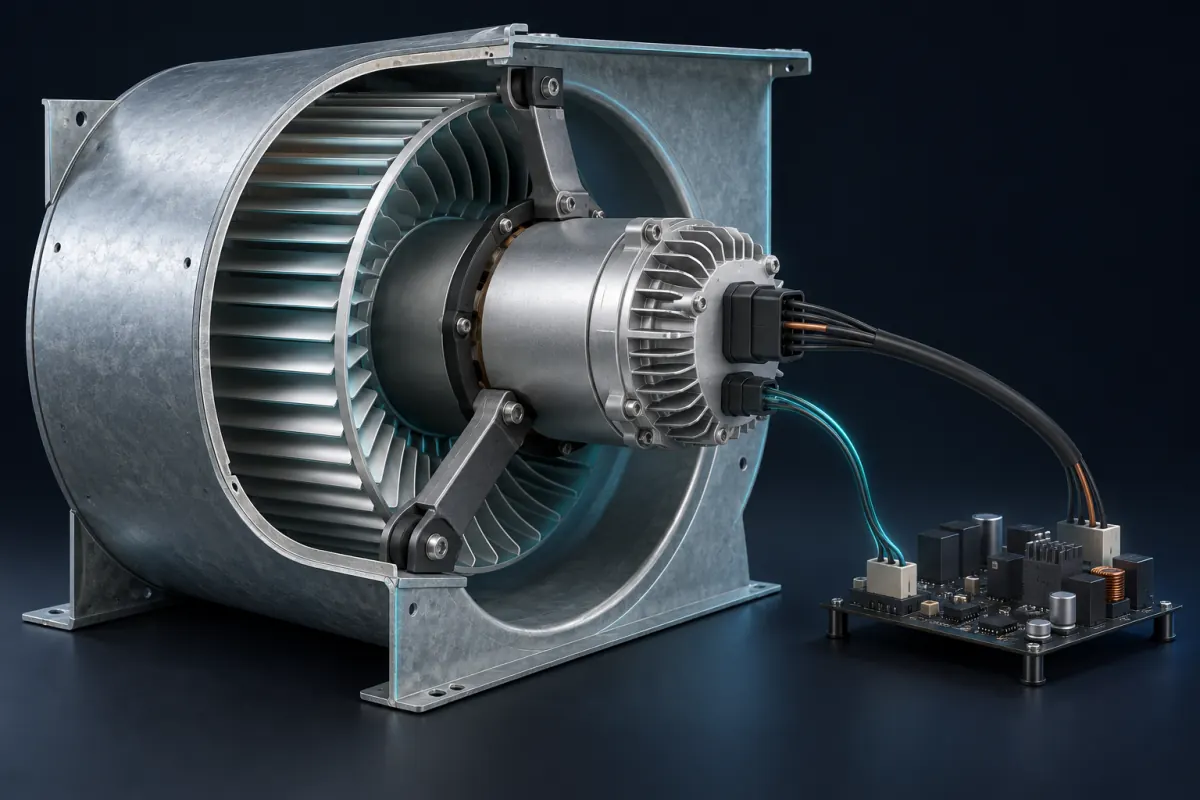
A variable-speed motor is different. It’s an ECM, an electronically commutated motor, with its own control module built onto the motor. The furnace board doesn’t power it directly; it sends low-voltage commands, and the motor’s module decides how fast to turn to deliver the airflow it’s asked for.
That’s what lets these motors ramp up and down gently and hold the airflow steady. It’s also what makes them hard to diagnose. When the blower won’t run, either the board isn’t sending the right command or the motor isn’t responding to a good one, and from the outside both look the same.
The tester that settles it
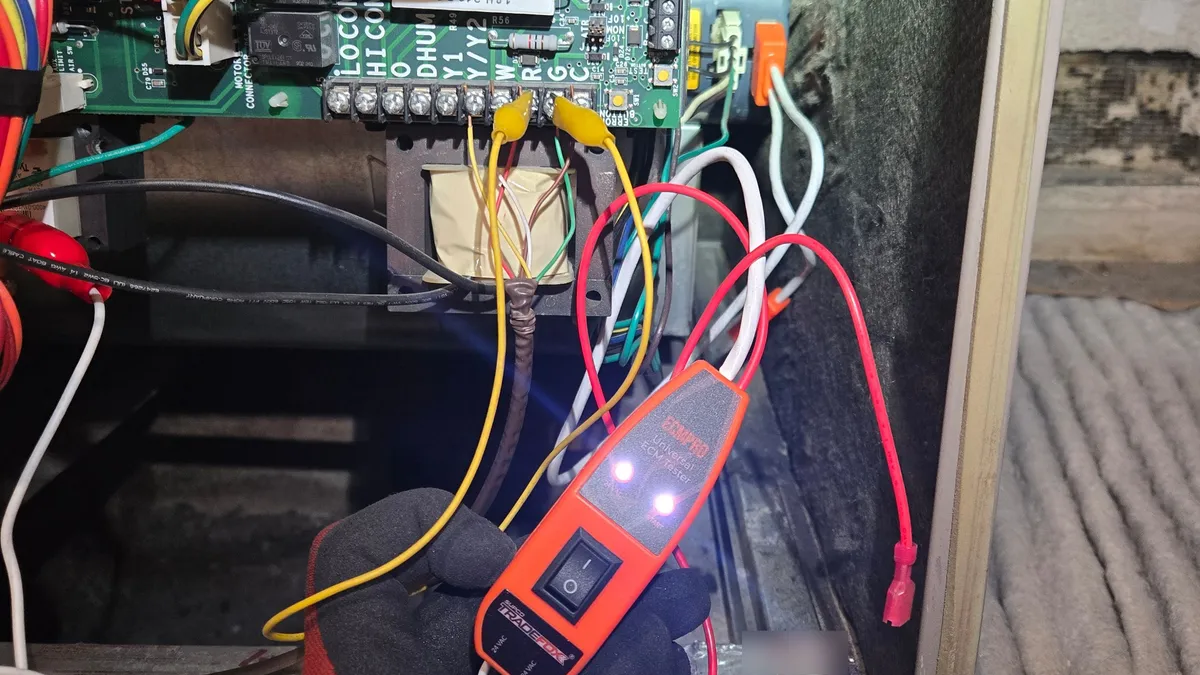
The orange tool in my glove in the photo is a universal ECM tester. It takes the board out of the question. With power to the motor, the tester sends it a run signal directly, so the motor either runs or it doesn’t.
If it runs, the motor is good and the problem is upstream, at the board or the wiring between them. If it won’t run on a good signal, the motor is the problem.
On this Lennox, the tester showed the blower motor was faulty. That meant the control board was fine.
What the photo shows
At the top of the photo is the furnace’s control board, with its strip of low-voltage terminals along the bottom edge. The tester’s yellow clips are on that strip, and its leads run down into the cabinet. Both of its indicator lights are on.
Why it matters which part you replace
On these systems, the control board is an expensive part, and the variable-speed blower motor costs even more. Replace the wrong one, and you’ve paid for a part that doesn’t fix anything, with the right part still to buy. A test that runs the motor by itself tells you which part to buy before you buy it.
Boards do fail too: in Porter Ranch, a furnace board stopped powering a good igniter, and that time the board was the part we replaced. Here, the test cleared the board. For a very different blower job, see the blower motor we replaced on a commercial rooftop unit.
The fix: a new blower motor
We replaced the blower motor, and the system worked normally after that. The control board stayed in place, since the test had already cleared it.
What can you check before you call?
Set the thermostat’s fan switch to ON for a minute. If air comes out of the vents, the blower can run; if it doesn’t, mention that when you call. Look at the filter as well, because a clogged one makes a variable-speed motor work harder to keep the airflow up. Make sure the furnace switch is on and the breaker hasn’t tripped, and count the blinks of the status light through the window in the lower door.
Don’t unplug the motor’s connectors or take the blower door off with the power on. Pulling these connectors live can damage the motor or the board, and the cabinet carries line voltage.
When to call
Call if no air comes from the vents with the fan set to ON, if the blower surges or stops and starts on its own, or if the status light keeps blinking a code.
Lennox furnace repair in Woodland Hills
We repair Lennox and other gas furnaces in Woodland Hills and across the San Fernando Valley, Hollywood and the Westside. The $85 service call is credited toward the repair if you go ahead, and repairs carry a 30-day labor and 90-day parts warranty. CA BEAR registered (#A 50636), EPA Section 608 Universal certified, $1M insured. See our HVAC services, read more about our work in Woodland Hills, or call (213) 205-2055.
FAQ
What is a variable-speed blower motor?
It's an ECM, an electronically commutated motor, with its own control module built onto the motor. The furnace control board sends it low-voltage commands instead of switching it on and off directly, and the motor adjusts its speed to deliver the airflow it's asked for.
How can you tell if it's the control board or the blower motor?
Run the motor on its own. A universal ECM tester sends the motor a run signal directly, without the furnace board. If the motor runs, the board side is the suspect; if it won't run on a good signal, the motor has failed. On this Lennox furnace in Woodland Hills, the tester showed the motor was faulty and the board was fine.
Why are variable-speed blower problems hard to diagnose?
The board and the motor work as a pair. The board commands the motor, so when the blower won't run, the fault can be on either side, and both look the same from the outside. On this Lennox in Woodland Hills, testing the motor separately is what settled it.
Is a variable-speed blower motor expensive to replace?
It's one of the more expensive parts in a furnace, and the control board isn't cheap either. That's why we test before replacing either one. You get the price after we diagnose the furnace on site, and the $85 service call is credited toward the repair if you go ahead.
Do you repair Lennox furnaces in Woodland Hills?
Yes. We repair Lennox and other gas furnaces in Woodland Hills and across the San Fernando Valley, variable-speed blower motors included. The $85 service call is credited toward the repair if you go ahead. Call (213) 205-2055.
AC, heater or mini-split acting up? We cover LA and the Valley.
Call (213) 205-2055 or text a photo of the unit and its model sticker.