
What salt air did to a Carrier condenser in Redondo Beach
A side-discharge outdoor unit close to the ocean, corroded all over. With a coil and a fan in that state, there was only one path: replacing the system.
In this guide
What we found on a Redondo Beach job
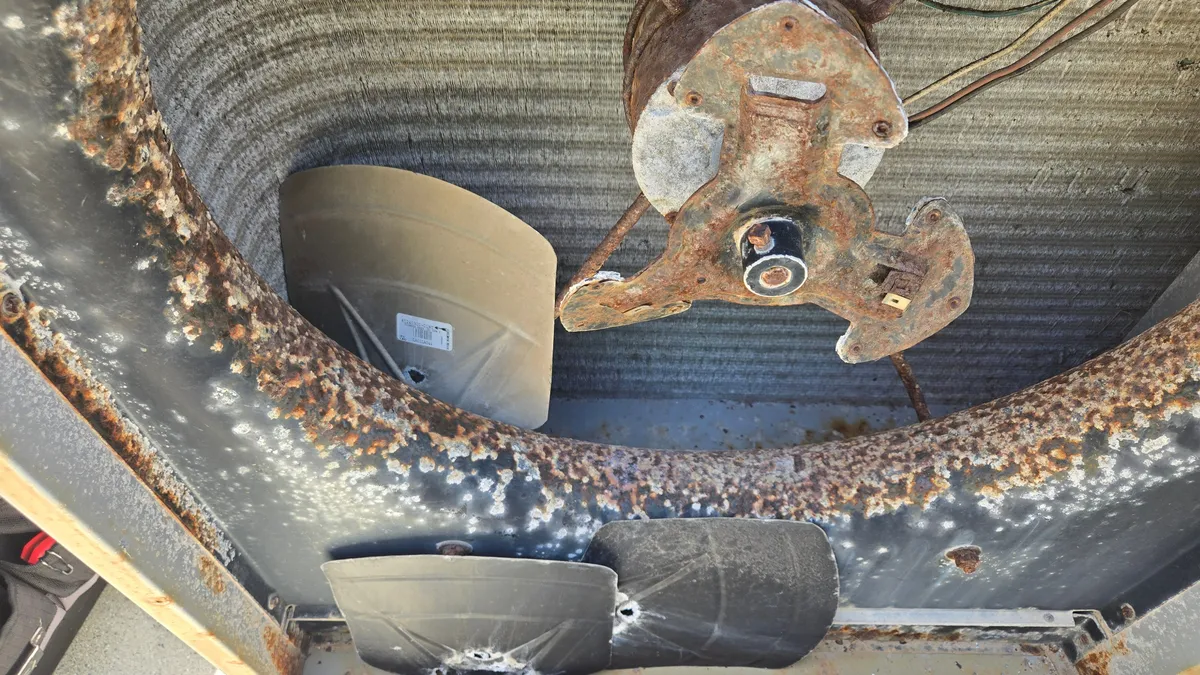
The unit was a Carrier side-discharge condenser in Redondo Beach. On a side-discharge unit, the fan blows the hot air out through the side of the cabinet instead of up through the top. This one was close to the ocean, and it was corroded all over. The condenser coil was in terrible condition. Its fan had fallen apart and rusted all over.
This is what salt air and a spot near the ocean can do to an air conditioner.
What the photos show
The photo at the top looks into the cabinet. Around the round opening the fan sits in, the metal is crusted with rust, and the paint is blistered and spotted with white deposits. Inside that opening, the fan motor and the bracket that holds it are heavily rusted. The fan’s hub still hangs on the motor, but its blades have broken off, and the broken pieces are lying at the bottom of the cabinet. Behind the fan you can see the condenser coil.
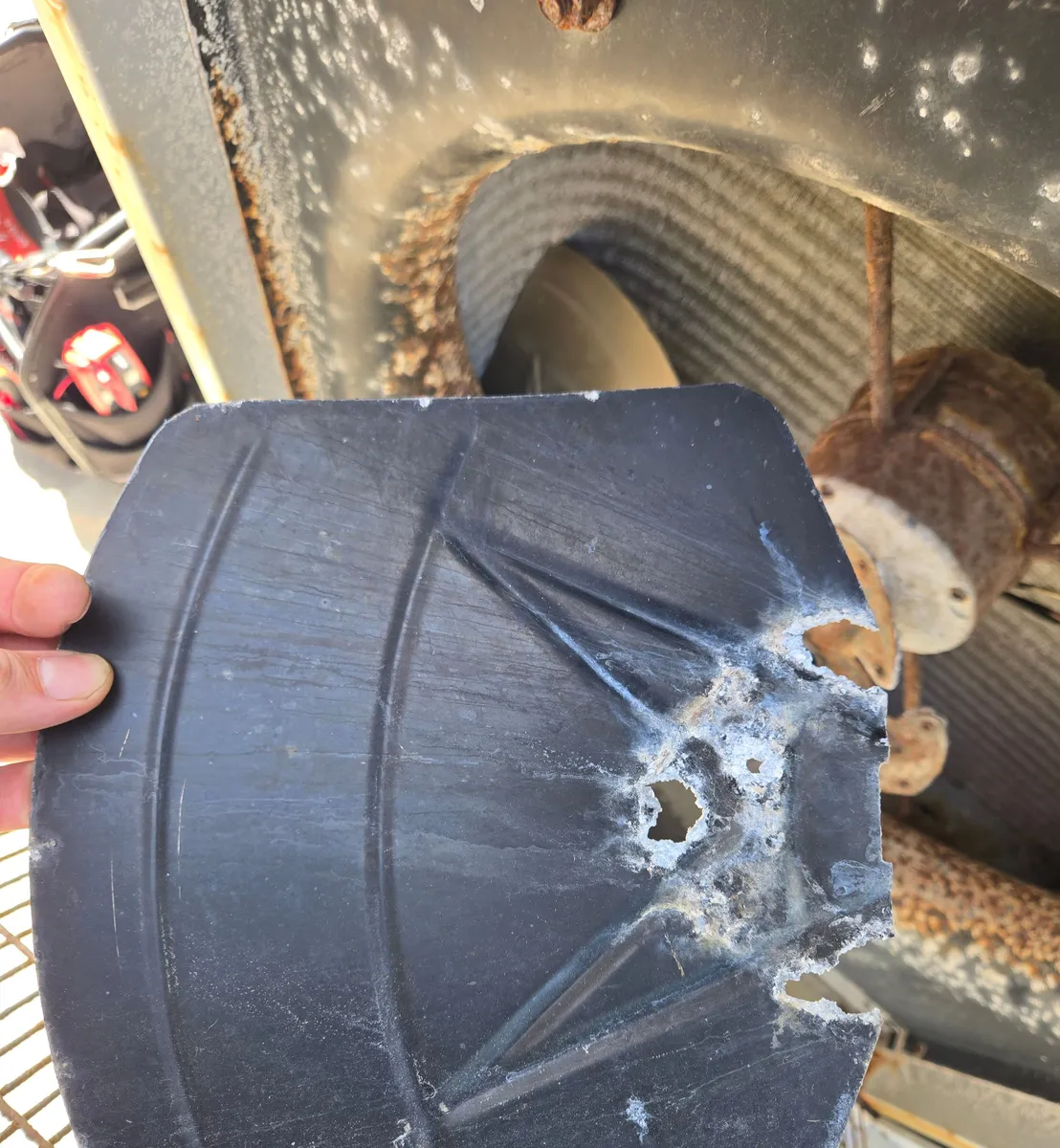
Photo two is one of those blades, in hand. Where it was fastened to the hub, the metal has corroded into holes rimmed with white powder, and the edges there are crumbling. Behind it are the rusted motor and the crusted fan opening.
Why does salt air corrode an air conditioner?
Air near the ocean carries salt. Waves and wind throw fine droplets of seawater into the air, the water evaporates, and tiny salt particles ride the breeze inland. They settle on whatever sits outside, outdoor units included.
Salt on metal doesn’t stay dry for long. It pulls moisture out of the air and holds it against the surface, and that wet, salty film is what lets corrosion run. Steel rusts once its paint or coating gives way. On this unit you can see it on the cabinet, the fan guard and the motor with its bracket.
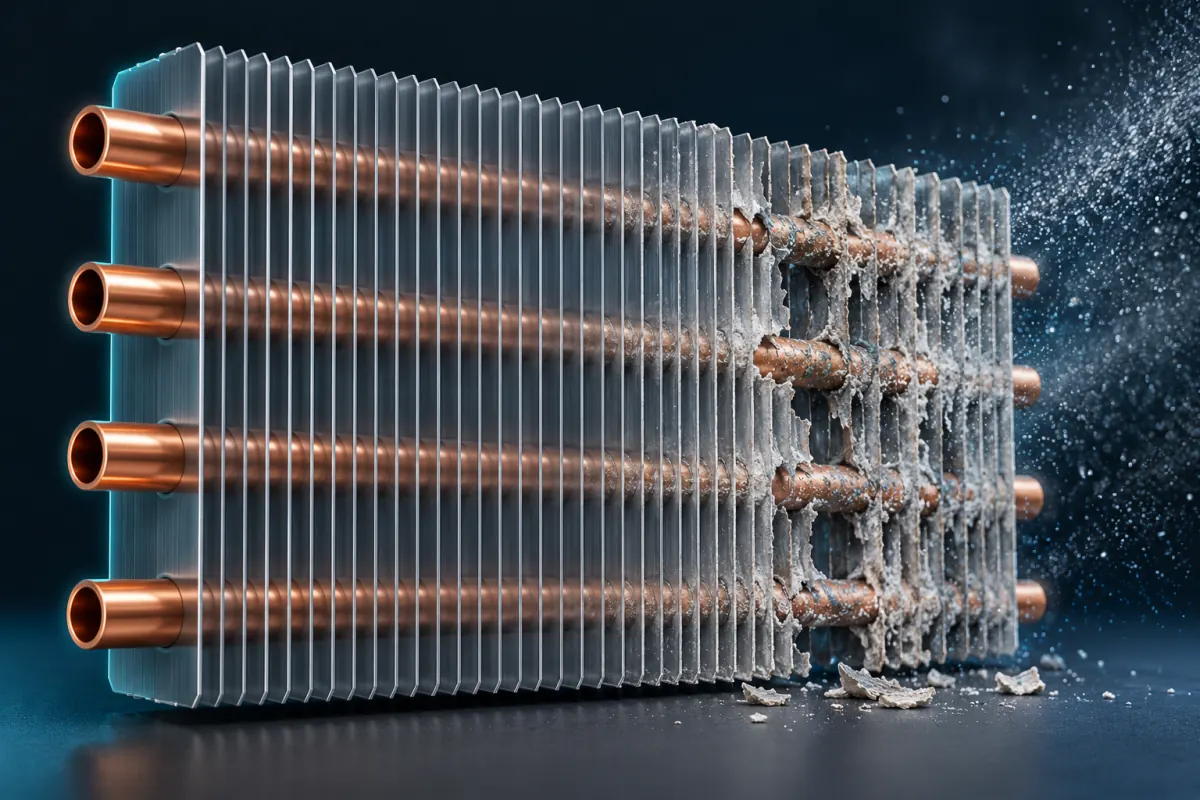
Condenser coils have a weak spot of their own. Many are built from copper tubes with thin aluminum fins pressed onto them, and when a film of salt water bridges those two metals, the aluminum corrodes first. The fins thin out and crumble. As they lose their grip on the tubes, the coil moves less heat, and in the end corrosion can open pinholes in the tubing and let the refrigerant out.
None of this takes a storm. It’s slow and steady, and an outdoor unit near the beach sits in it all year.
Why replacement was the only path
With a coil in terrible condition and a fan that has fallen apart, there’s no single broken part to fix. The corrosion is the whole unit. New blades and a new motor would leave the ruined coil and the rusted cabinet in place. A cleaning wouldn’t save the coil either: it takes off dirt and salt, but it can’t put back metal that has already corroded away. So there was one sensible path here, and it’s what we recommended: replacement.
And because the unit wasn’t new, replacement meant the whole system, not just the outdoor unit. An air conditioner’s indoor coil and outdoor unit are designed to work as a matched pair. A brand-new outdoor unit hooked up to an indoor section that isn’t new may not be a proper match for it. We explained matched systems in more detail in a write-up about an older system with a leaking condenser coil in Sherman Oaks.
How to protect an AC near the beach
You can’t keep salt out of the air, but you can keep it from building up on the unit.
Keep the outdoor coil clean. From time to time, rinse salt and dirt off it with fresh water from a garden hose, gently and at low pressure. Before you do, switch the system off at the thermostat and the power off at the outdoor disconnect. A pressure washer bends fins, so leave it in the garage. Keep the area around the unit clear, too, so air moves freely through the coil.
The habit matters more than any single cleaning. A rinse only helps with the salt that hasn’t done its work yet.
Watch for early signs: white powder or flaking on the fins, rust spreading on the cabinet and its screws, or a fan that starts to wobble or sound different. Ask the technician to look for corrosion whenever the unit is serviced.
If the outdoor unit does need replacing near the coast, ask about equipment meant for coastal installs. Coils with protective coatings exist for exactly that.
When to call
Call if the outdoor fan isn’t turning or makes a new noise, if you can see rust holes or crumbling fins, or if the system isn’t cooling the way it used to. A fan that’s coming apart can do more damage while it spins, so if you hear scraping or rattling from the outdoor unit, switch the system off at the thermostat first.
AC service in Redondo Beach
We service air conditioners in Redondo Beach and the rest of the South Bay. An AC tune-up includes coil cleaning, and on a coastal unit it’s a good time to catch corrosion early. The $85 service call is credited toward the repair if you go ahead, and repairs carry a 30-day labor and 90-day parts warranty. CA BEAR registered (#A 50636), EPA Section 608 Universal certified, $1M insured. See our HVAC services or call (213) 205-2055.
FAQ
Does salt air damage air conditioners near the beach?
It can. Salt from sea air settles on outdoor units and holds moisture against the metal, which speeds up corrosion. Steel parts rust, and the aluminum fins on a copper-tube coil corrode and crumble. This Carrier condenser in Redondo Beach, close to the ocean, was corroded all over.
Can a corroded AC condenser be repaired?
It depends on how far the corrosion has gone. On this unit, the condenser coil was in terrible condition and the fan had fallen apart, so there was no single part to fix. Replacement was the only sensible path.
Why replace the whole system instead of just the outdoor unit?
The indoor and outdoor sections are designed to work as a matched pair. When a system isn't new, a new outdoor unit may not match the indoor section that's there. This unit wasn't new, so the path was a full system replacement.
How can I protect my AC from salt air?
Keep the outdoor coil clean. With the system off at the thermostat and the power off at the outdoor disconnect, rinse the coil gently with fresh water from a garden hose now and then. Keep the area around the unit clear, and have it checked for corrosion when it's serviced. If you're replacing equipment near the coast, ask about coated coils.
Do you service air conditioners in Redondo Beach?
Yes. We service and repair air conditioners in Redondo Beach and across the South Bay. The $85 service call is credited toward the repair if you go ahead. Call (213) 205-2055.
AC, heater or mini-split acting up? We cover LA and the Valley.
Call (213) 205-2055 or text a photo of the unit and its model sticker.