
A burned-out condenser fan motor in the Hollywood Hills: the capacitor failed first
The customers said their AC wasn't cooling. The fan motor on the outdoor unit had burned out, and a failed capacitor was the reason.
In this guide
The complaint: an AC that wasn’t cooling
The customers in the Hollywood Hills told us their air conditioner wasn’t cooling. Outside, on the condenser, we found the trouble: its fan motor had burned out, and we replaced it.
That motor wasn’t the whole story, though. It burned out because of the capacitor.
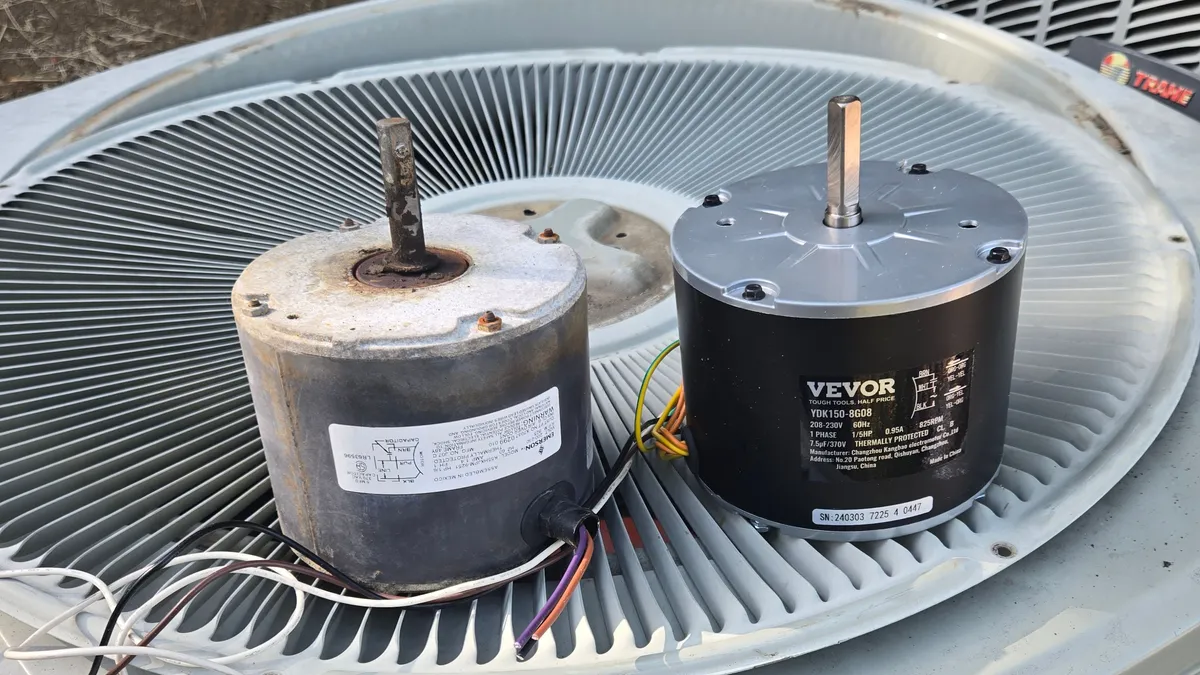
What the photo shows
Both motors are sitting on the fan grille on top of the condenser. The one on the left burned out: its paint is worn and its shaft is rusted. The one on the right is the replacement, black and clean.
Look at the labels. The old motor’s says it’s thermally protected, and it lists the capacitor the motor runs with. On the new motor, the label lists its voltage and speed next to the capacitor rating it calls for.
The capacitor failed first
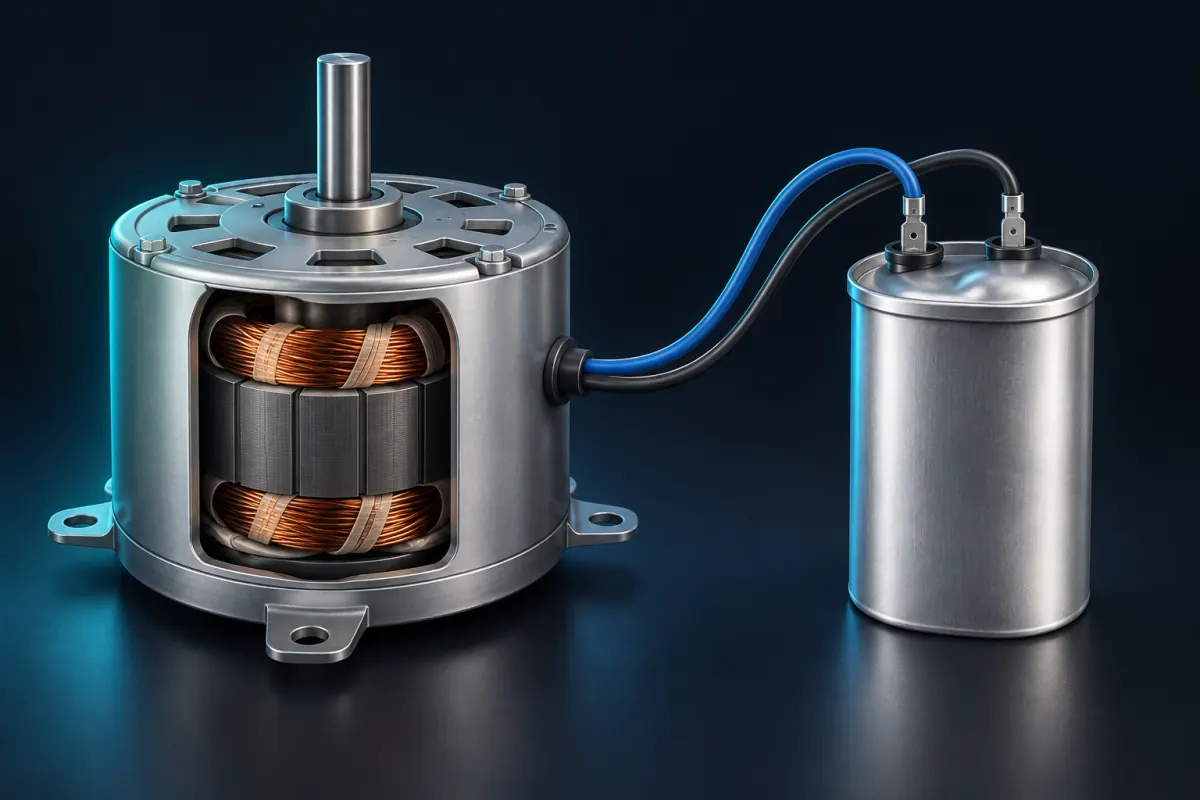
On this job, the chain went like this. The capacitor failed. Without it, the motor couldn’t start, so it overheated trying, and in the end it burned.
A fan motor like this one runs with a capacitor wired to its second winding. The capacitor shifts the current in that winding, which gives the motor the rotating push it needs to start turning in the right direction, and it keeps helping while the motor runs. When the capacitor dies, the motor still gets power but can’t get going. It just sits there humming, drawing heavy current and heating up.
There’s a safeguard for that. A thermal protector inside the motor cuts the power when the windings get too hot. It buys time, but it can’t fix a dead capacitor: the motor cools down, tries again, stalls again and heats up again. Run that loop long enough and the insulation on the windings breaks down, and that’s a burned-out motor.
A new motor needs a good capacitor
When a capacitor is what killed a fan motor, the new motor needs a working capacitor of the rating printed on its own label. Hook a new motor to the old, dead capacitor and it can’t start either. It would just head down the same road.
Capacitors are rated in microfarads and volts, and both numbers are on the labels in this photo. A replacement capacitor has to match the microfarads the motor calls for, and its voltage rating has to be at least as high as the one specified. Close enough isn’t good enough here, because the wrong value can leave a motor running weak and hot.
Why does the condenser fan matter so much?
The condenser fan pulls outdoor air through the condenser coil, and that air carries away the heat your system took out of the house. When the fan stops, the heat has nowhere to go. Pressure and temperature on the hot side of the system climb, and the compressor keeps pumping against them.
It’s also why the house stops cooling. Refrigerant that can’t give up its heat outside can’t pick up much more from the air inside, so the air from the vents turns warm.
That’s another reason to take a capacitor seriously: a bad one can take out the compressor too.
Many condensers have a pressure switch that cuts the compressor off when the pressure gets too high. On one of three systems at a Downtown LA restaurant, the condenser fan’s capacitor was dead, the pressure in the liquid line got very high, and the pressure switch kept shutting the compressor off. A switch like that protects the compressor from the worst of it. Even so, a compressor that keeps running hot is under real stress.
There’s another link between the two. In many outdoor units a single capacitor serves both the fan motor and the compressor, so when it weakens, the compressor can struggle to start as well. We’ve written about how a failing capacitor can leave a compressor straining at start until it burns out.
Signs a capacitor is getting weak
A capacitor can weaken for a while before it quits for good. On the outdoor unit, that can look like a fan that’s slow to get up to speed, one that needs a few tries to start, or a hum from the unit before the blade finally moves. Any of those is a reason to have the capacitor tested before the motor pays for it.
Have the capacitor checked
The lesson from this job: check the capacitor. A technician tests it with the power off and the capacitor safely discharged, measuring its capacitance against the rating on its label. One that reads well below its rating, or one that’s bulging or leaking, gets replaced before it takes a motor or a compressor down with it. That test is part of our AC tune-up.
What you can check yourself
Set the thermostat to cool and look at the outdoor unit. The fan on top should be spinning. If you hear the unit humming or running but the blade is still, or it turns slowly and stops, switch the system off at the thermostat. That protects the compressor while you wait for help.
Don’t push a stick or anything else through the grille to get the fan going, and don’t open the electrical panel. There’s line voltage inside, and a capacitor can hold a charge even after the power is off.
If nothing outside runs at all, check the AC breaker in your electrical panel. A tripped breaker can be reset once. Should it trip again, leave it off and call.
When to call
Call if the outdoor fan isn’t spinning while the unit runs, if the air from your vents is warm, or if the outdoor unit hums, smells like something is burning, or keeps shutting off and starting again. Turning the system off and calling early costs a lot less than a compressor.
AC repair in the Hollywood Hills
We repair central AC condensers in the Hollywood Hills, Hollywood and across Los Angeles. The $85 service call is credited toward the repair if you go ahead, and repairs carry a 30-day labor and 90-day parts warranty. CA BEAR registered (#A 50636), EPA Section 608 Universal certified, $1M insured. See our HVAC services or call (213) 205-2055.
FAQ
Why did my AC condenser fan motor burn out?
On this Hollywood Hills job, the capacitor failed first. Without it, the motor couldn't start, so it overheated and burned. A fan motor that hums but won't turn can be stuck for the same reason, and leaving it in that state is what cooks the windings.
What does a capacitor do for a condenser fan motor?
It shifts the current in the motor's second winding so the motor can start turning, and it keeps helping while the motor runs. With a dead capacitor, the motor gets power but can't start: it hums, draws heavy current and heats up.
Can a bad capacitor damage the compressor?
It can. With the condenser fan stopped, the heat can't leave the outdoor unit, so pressure and temperature climb while the compressor keeps pumping. In many units one capacitor also helps start the compressor, so a weak one makes it struggle at startup. That's why we test capacitors during maintenance.
Can I test or replace an AC capacitor myself?
We don't recommend it. A capacitor can hold a charge even after the power is off, and the panel around it carries line voltage. If the outdoor fan isn't spinning, switch the system off at the thermostat and call.
Do you repair AC condensers in the Hollywood Hills?
Yes. We repair central AC condensers in the Hollywood Hills and across Los Angeles. The $85 service call is credited toward the repair if you go ahead, and repairs carry a 30-day labor and 90-day parts warranty. Call (213) 205-2055.
AC, heater or mini-split acting up? We cover LA and the Valley.
Call (213) 205-2055 or text a photo of the unit and its model sticker.