
A mini-split in San Fernando that didn't cool: the flare nuts were only hand-tight
A two-zone system that didn't cool after the owners moved in. At the outdoor unit, the line set connections had only been started by hand.
In this guide
What the owners noticed
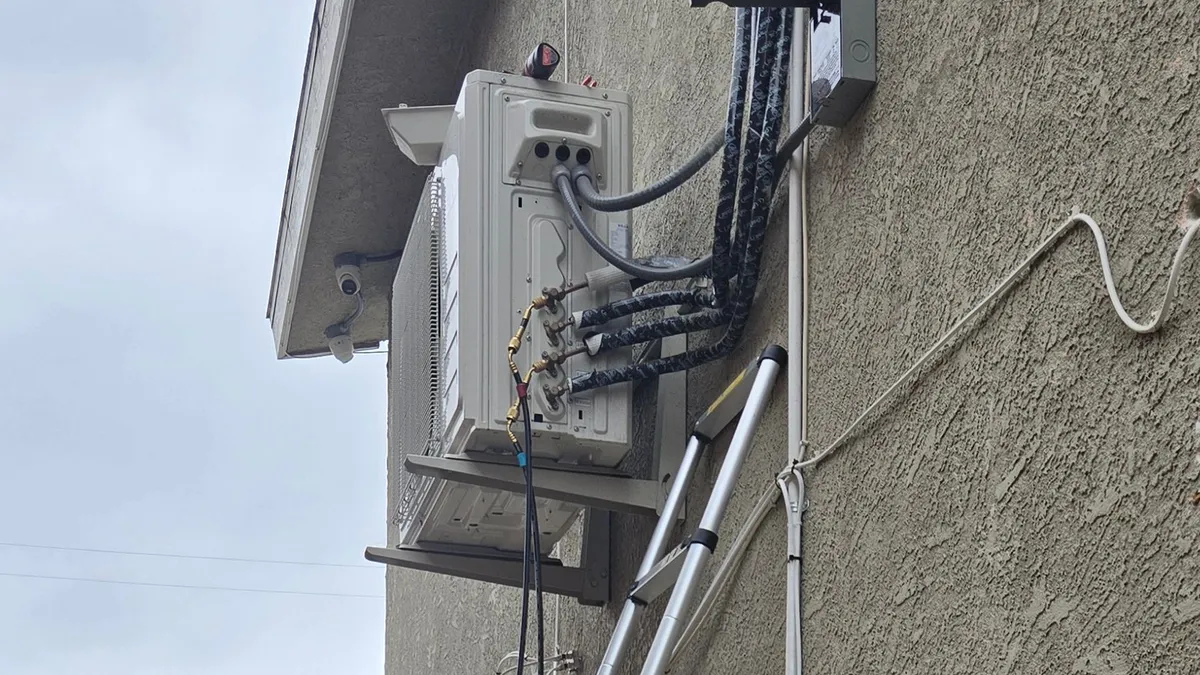
The owners moved in and found that their mini-split didn’t cool. It’s one system with two indoor units, and its outdoor unit hangs on a wall bracket high on the side of the building.
Why wasn’t it cooling?
We found the answer at the outdoor unit, where the line sets connect. On a system like this, each indoor unit has its own pair of copper lines. Each line ends in a flare nut that screws onto a fitting on the side of the outdoor unit.
Those nuts were only hand-tight. They’d been started by hand and left that way.
What “started by hand” means
That’s how a flare nut is supposed to start. You thread it on with your fingers so it can’t cross-thread, and up to that point nothing is wrong. The next step is the one that matters: tightening the nut to the torque the manufacturer specifies, with a second wrench holding the fitting so it doesn’t twist. On this system, that step was missing.
What the photo shows
In the photo at the top of this page, the outdoor unit sits on its bracket under the eave. The insulated line sets leave the side of the unit, where the flare connections are, and run up the wall. Service hoses are hooked up at the ports beside them, which is how a technician connects a vacuum pump and refrigerant to the system.
How a flare connection seals
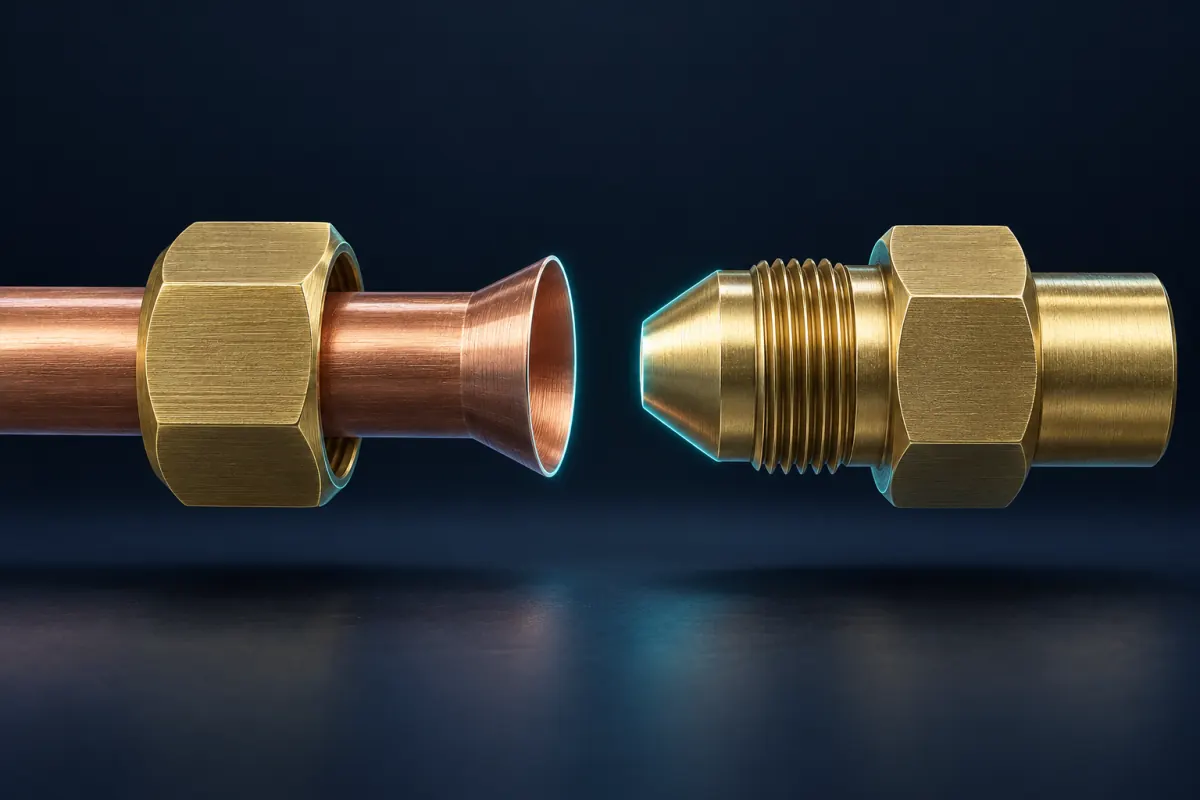
A standard flare joint seals metal to metal. The end of the copper line is flared into a cone, and the nut presses that cone against a matching cone on the fitting. That seal holds only at the torque listed for the nut’s size. Installation manuals give those values, and the tool for the job is a torque wrench.
Too loose, and refrigerant escapes at the joint. Too tight, and the flare can crack. A nut that’s only been turned by hand is about as loose as a connection gets. It can’t hold the pressure inside a running system.
Why tightening the nuts isn’t the whole fix
On most mini-splits, the outdoor unit ships with its refrigerant charge held behind closed service valves. The installer connects the line sets, pulls a vacuum on the lines and the indoor units, and then opens the valves to let the refrigerant into the rest of the system. From then on, each flare joint has to hold system pressure.
A joint that can’t hold that pressure lets refrigerant out. Air and moisture can also get into a system that’s been open, and neither belongs in a refrigerant circuit: air takes up room the refrigerant needs, and moisture can freeze in narrow passages or react with the oil.
So once connections like these have been leaking, snugging the nuts down doesn’t finish the job. The system has to be evacuated and then charged.
What we did
We made the connections up properly. Then we evacuated the system, which means running a vacuum pump to pull air and moisture out of the lines and the indoor units, and charged it with refrigerant. After that, the mini-split cooled well.
Other ways a system loses its charge
Hand-tight flare nuts are one way to lose a charge, and we’ve written up others. In Torrance, plumbing Teflon tape on the flare fittings cost a brand-new system its whole charge. A heat pump in Santa Monica ran out of refrigerant because a service valve had been cranked too tight.
What you can check yourself
Start with the settings. The remote or wall control should be in cool mode, set below the room temperature. Then check the breaker for the outdoor unit.
After that, switch the system off and lift the front panel of each indoor unit to check the filters. Wash them if they’re dusty. Once it’s back on, look at the outdoor unit and note whether its fan is running, since that’s useful for the technician to know.
Leave the line set connections alone. Handling refrigerant requires EPA Section 608 certification, and liquid refrigerant can cause frostbite. A system that’s lost refrigerant also has to be evacuated and charged, which takes more than a wrench.
When to call
If the indoor units blow air that isn’t cold, switch the system off and call. Same for oily residue around the connections at the outdoor unit: refrigerant carries oil through the system, so oil at a joint often marks a leak.
Mini-split service in San Fernando
We service ductless mini-splits in San Fernando and across the San Fernando Valley. The $85 service call is credited toward the repair if you go ahead, and repairs carry a 30-day labor and 90-day parts warranty. See our mini-split service page, or read more about our work in San Fernando. CA BEAR registered (#A 50636), EPA Section 608 Universal certified, $1M insured. Call (213) 205-2055.
FAQ
Why would a mini-split not cool after you move in?
Several things can cause it, from a wrong setting to a refrigerant problem. In this San Fernando case, the flare nuts at the outdoor unit had only been started by hand, so the line set connections couldn't seal.
Can a loose flare nut leak refrigerant?
Yes. A flare joint seals metal to metal and holds only when the nut is tightened to the manufacturer's torque. A hand-tight nut can't hold the pressure inside a running system.
Is tightening the flare nuts enough to fix it?
Not once the joints have been leaking. Refrigerant may be gone, and air and moisture may be inside, so the system has to be evacuated and charged. On this job we made the connections up properly, evacuated the system and charged it.
Can I tighten the flare nuts myself?
No. Handling refrigerant requires EPA Section 608 certification, and a system that has been leaking needs evacuating and charging afterward. Turn the system off and call.
Do you service mini-splits in San Fernando?
Yes. We service ductless mini-splits in San Fernando and across the San Fernando Valley. The $85 service call is credited toward the repair if you go ahead.
AC, heater or mini-split acting up? We cover LA and the Valley.
Call (213) 205-2055 or text a photo of the unit and its model sticker.