
A gas oven in Chatsworth that wouldn't heat, or took very long to: we replaced the igniter
An oven repair in Chatsworth, August 2026. How the igniter and the oven's gas safety valve work together, and why a glowing igniter can still be the problem.
In this guide
A gas oven that won’t heat, or takes very long to, is a typical igniter problem, and an igniter that glows doesn’t rule it out. In August 2026 we replaced the igniter on a gas oven in Chatsworth with exactly that complaint.
The complaint: no heat, or heat that took very long
The oven either didn’t heat or took a very long time to get there. That’s a typical problem on gas ovens, and on this one the repair was a new igniter.
There isn’t much more to the job than that. The part is worth understanding, though, because a worn igniter can fool you: it still glows. What follows explains how the part works in general. It isn’t a report of readings from this oven.
What the photo shows
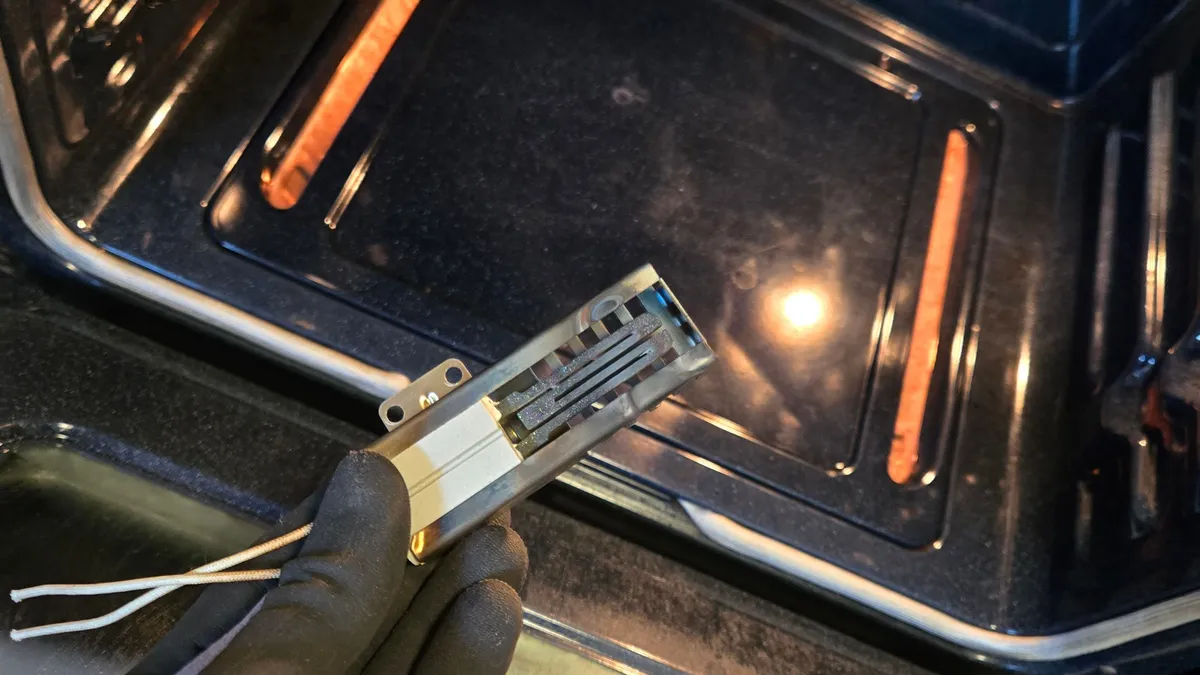
In the photo at the top of this page, an igniter is in my glove, in front of the open oven. It’s the flat type, a gray element with slots cut along its length. A slotted metal guard with mounting tabs holds it, and two white braided wires leave from its white ceramic base.
An igniter like this usually sits beside the bake burner, under the oven floor. GE’s support pages call this kind of part a Glo-Bar.
How does a gas oven igniter open the gas valve?
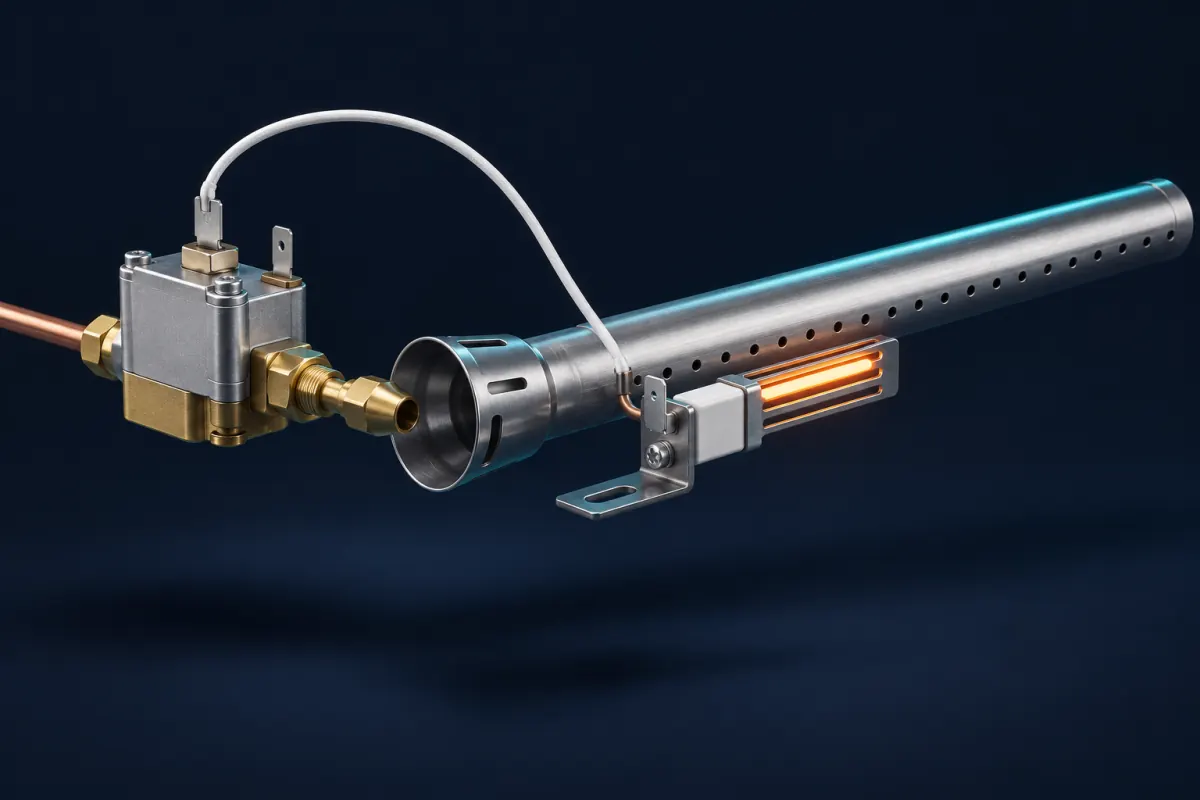
When you set a gas oven like this one to bake, the control sends power through two parts at once: the igniter and the oven’s gas safety valve. They’re usually wired one after the other, in series, so the same current flows through both.
The igniter heats up first. As it gets hotter, its resistance drops and more current flows. Inside the valve, that current warms a small bimetal element, two metals bonded together that bend as they heat. Once the current reaches the level the valve is built for, the bimetal bends far enough to open the valve. Gas flows to the burner, and the igniter, already hot, lights it.
That order is the safety feature. The valve can’t open until the igniter is hot, so gas doesn’t flow to a burner with nothing to light it. GE’s page on normal gas range operation describes the same link from the other end: the igniter stays on as long as the flame is burning, and when it’s switched off, the safety valve closes and the flame goes out.
Why can a weak igniter glow and still not heat the oven?
An igniter wears with use, and its resistance creeps up. It can keep glowing orange, so it looks fine, while it passes less current than the valve needs.
If the current barely reaches the valve’s level, the valve opens late, after a long wait, and the oven is slow to heat. Short of that level, the valve stays shut and the oven doesn’t heat at all.
There’s a second cost. An oven holds its temperature by turning the burner off and on, and the igniter switches off with the flame. A weak igniter can drag out each of those heating cycles, the first preheat included.
Those are the two complaints this customer had: no heat, or heat that took very long.
How a technician tells a weak igniter from the rest
Not by the glow. With the oven calling for heat, a technician measures the current through the igniter circuit and compares it with the range the manufacturer gives for that oven in its service data. An igniter that passes the eye test can fail that one.
The same checks help separate the igniter from its neighbors. No glow at all can mean a burned-out igniter, or no power reaching it from the control. An igniter that draws what the spec calls for while the burner still won’t light points past the igniter, to the valve or the gas supply.
What else can make a gas oven slow to heat?
The igniter is a typical cause, not the only one. A temperature sensor that reads wrong can make the control shut the burner off too early. The safety valve itself can fail. A problem with the gas supply can starve the burner, and a door that doesn’t seal lets heat escape.
Electronic controls fail too. On an electric wall oven that stalled at 200°F, we traced the problem to a single burnt relay on the control board. That’s why a slow oven deserves a diagnosis before anyone buys parts. Our guide to why an oven isn’t heating covers gas and electric ovens.
What you can safely check
Start with the settings. Make sure the oven is set to bake and isn’t in a delayed-start or Sabbath mode. A gas oven with a glowing igniter still needs electricity, so if the display is dark, check the breaker.
Then watch, without touching anything. With the oven set to bake, you may see an orange glow through the openings in the oven floor. GE notes that this glow is normal and is often mistaken for the flame. Note roughly how long it takes before you hear the burner light, and tell the technician.
Don’t pull out the oven floor, test the igniter circuit or loosen anything on the gas line. If the burner lights with a loud whoomp instead of a soft one, stop using the oven and call.
If you smell gas, don’t use the oven, and don’t switch lights or appliances on or off. Leave the house and call the gas company or 911 from outside.
Oven repair in Chatsworth
We repair gas and electric ovens and ranges in Chatsworth and across the San Fernando Valley. See oven repair and stove and range repair. The $85 service call is credited toward the repair if you go ahead, and the price comes after we diagnose the oven on site. Repairs carry a 30-day labor and 90-day parts warranty. CA BEAR registered (#A 50636), EPA Section 608 Universal certified, $1M insured. Call (213) 205-2055.
FAQ
Why does my gas oven take so long to heat?
On ovens that light with a glowing igniter, a worn igniter is a typical cause. It can glow but pass too little current for the gas safety valve to open promptly, so the burner lights late. A temperature sensor, the safety valve itself, the control or the gas supply can also be behind it, so it needs a diagnosis. On this oven in Chatsworth, we replaced the igniter.
My oven igniter glows. Can it still be bad?
Yes. On ovens where the igniter and the gas safety valve are wired in series, the valve opens only when enough current flows through the igniter. A worn igniter can glow and still pass too little, so the valve opens late or stays shut.
How is a weak oven igniter tested?
Electrically, not by eye. With the oven calling for heat, a technician measures the current through the igniter circuit and compares it with the manufacturer's specification for that oven. Leave that test to a technician.
What should I do if I smell gas near my oven?
Don't use the oven, and don't switch lights or appliances on or off. Leave the house and call the gas company or 911 from outside.
Do you repair gas ovens in Chatsworth?
Yes, gas and electric ovens and ranges in Chatsworth and across the San Fernando Valley. The $85 service call is credited toward the repair if you go ahead, and repairs carry a 30-day labor and 90-day parts warranty.
Got an appliance that needs fixing? We cover LA and the Valley.
Call (213) 205-2055 or text a photo of your appliance.