
An empty Fujitsu multi-zone mini-split in West Hollywood, and why ducted systems like it leak so often
March 2025. A multi-story home with ducted indoor units hidden in the ceilings. The system had no refrigerant left. We found the leak, repaired it, evacuated and recharged, and it works.
In this guide
A Fujitsu multi-zone mini-split in a multi-story West Hollywood home had no refrigerant left. That’s the most frequent problem on systems like this one, which feed ducted indoor units hidden in the ceilings. We tested the system, found the leak and repaired it, then tested again, evacuated the system and charged it. It works.
What kind of system is this?
It’s a typical setup in multi-story West Hollywood homes. One outdoor unit, this time a Fujitsu, serves several indoor units, and each indoor unit cools its own zone. Here the indoor units are ducted: instead of white boxes on the walls, they sit above the ceilings and push air through ducts to grilles in the rooms.
From inside the home you barely see the system at all. You see grilles in the ceiling, while the air handlers and most of the refrigerant piping stay out of sight.
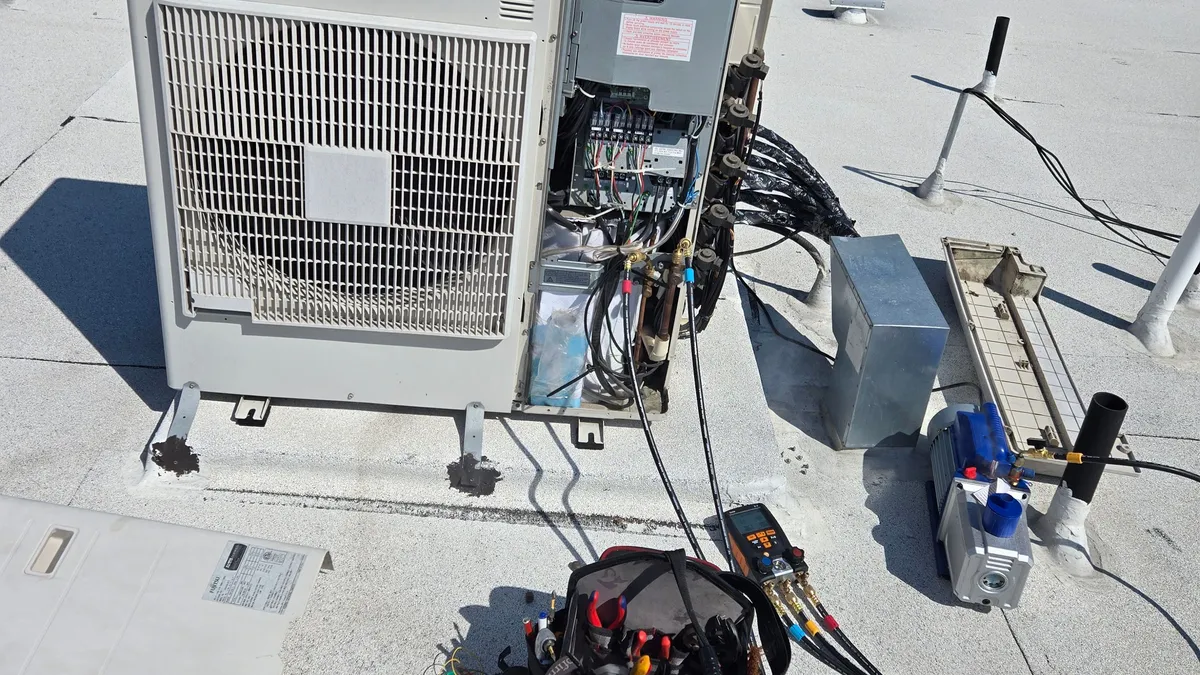
The photo at the top of this page is from the job, in March 2025: the outdoor unit sits on the roof with its service side open, a bundle of insulated line sets runs off one side, and gauge hoses are connected to its service ports.
Why do multi-zone ducted mini-splits leak so often?
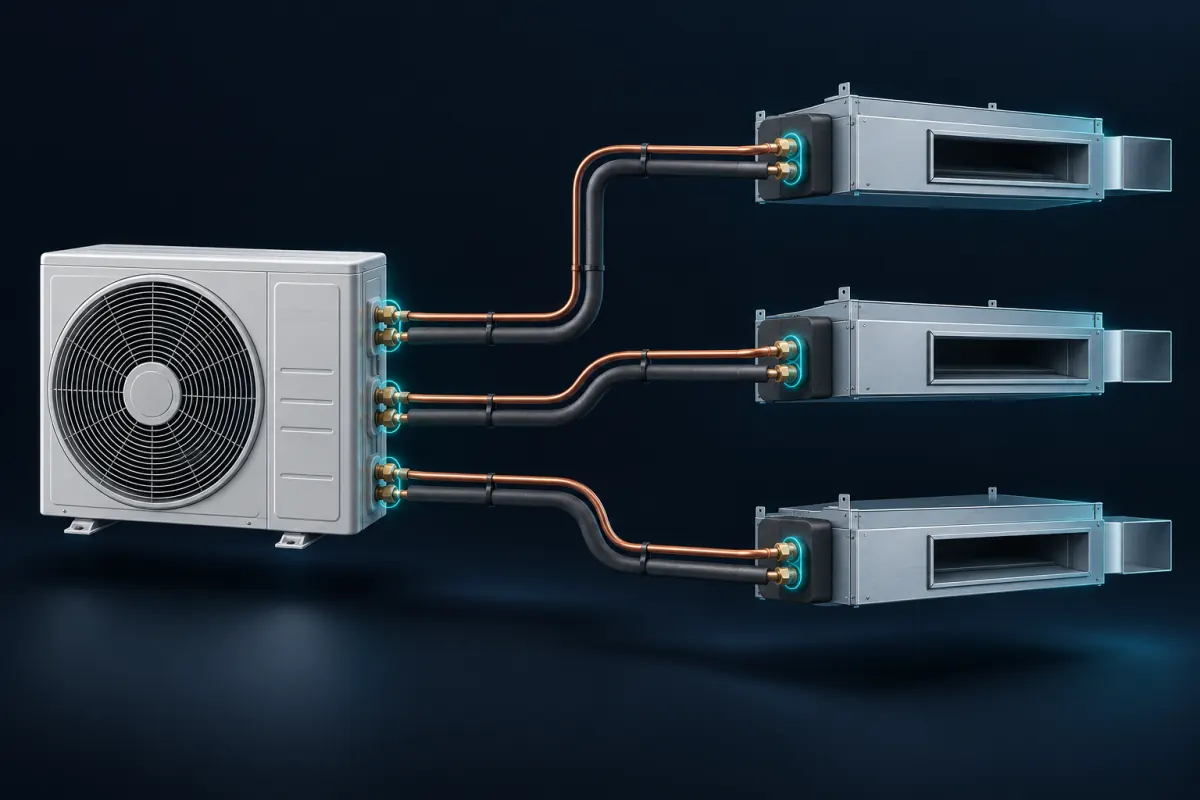
Mostly because of how many connections they have. Each indoor unit gets its own pair of refrigerant lines, a smaller liquid line and a larger gas line, running back to the outdoor unit. On mini-splits, those lines usually join the equipment with flare connections: the end of the copper is flared out and clamped against a fitting by a threaded nut. Each line has a joint like that at each end. Add zones, and the number of joints climbs quickly.
Each of those joints is a place where refrigerant can get out. Leaks can also show up elsewhere in the system, often in the evaporators, the indoor coils that sit inside those hidden air handlers.
So these are fairly complex systems, and they leak often. This one ran true to form: when we got to it, the system was empty.
How does a flare connection start to leak?
A flare seals metal against metal, held tight by the nut. That’s a good seal when the flare is cut and formed cleanly and the nut is tightened correctly. Over time, though, temperature swings and vibration work on the joint, and a flare that was slightly off from the start, or tightened too little or too much, can begin to let refrigerant through.
Shortcuts make it worse. Plumbing tape doesn’t belong on a flare. We wrote about a brand-new system in Torrance that lost its whole charge at flare fittings someone had wrapped in Teflon tape.
On a ducted system, there’s an extra problem: the joints at the indoor units sit above the ceiling. A slow leak there doesn’t drip anything or make noise you’d notice. The system just cools a little worse over time, until it can’t cool at all.
What we did
Tested the system and found the leak
The system was empty, so we started with a leak test. For an empty system, that usually means putting the refrigerant circuit under pressure with dry nitrogen, then checking the joints and the coils until the escaping gas gives the spot away. On a multi-zone system with hidden indoor units, the search can lead well away from the outdoor unit. Take another ducted mini-split we worked on: the leak turned out to be a quick-connect fitting above a closet ceiling, which we cut out and brazed.
On this one, we found the leak and repaired it.
Tested the repair
A repair isn’t done until it proves it holds. After the fix, we tested the system again before any refrigerant went back in.
Evacuated and charged the system
Next, we evacuated the system. A system that has leaked empty has been open to the outside air, so air and moisture can be inside it, and a vacuum pump pulls them out. Moisture in a refrigerant circuit can react with the refrigerant and the oil, and air takes up room that belongs to the refrigerant.
Then we charged the system with refrigerant. It works.
Why topping it off doesn’t fix it
Refrigerant doesn’t get used up. A mini-split that keeps needing more has an opening somewhere, and a new charge leaves through the same opening, sooner or later. On a multi-zone system, that means paying for refrigerant again and again for the same leak. Finding the leak is the repair, and the charge goes in only after that.
What you can check yourself
If one zone or all of them blow warm air, start with the controls. Make sure each remote or wall control is set to cool and below the room temperature.
Ducted units have air filters too, usually behind a return grille. A clogged filter cuts the airflow and makes any system cool poorly, so check the ones you can reach and clean or replace them if they’re dirty.
If nothing runs at all, check the breaker. Leave the rest to a technician. Don’t open the indoor or outdoor units, and if the outdoor unit is on the roof, as this one was, don’t climb up to look at it.
When to call
Call if a zone, or the whole system, runs but doesn’t cool, or if the system has been topped off before and lost its cooling again. On a ducted system, a slow leak hides well, so a system that slowly loses its cooling deserves a look, too.
Mini-split repair in West Hollywood
We repair ductless and ducted mini-splits in West Hollywood and across the Westside, Hollywood and the San Fernando Valley, multi-zone systems included. The $85 service call is credited toward the repair if you go ahead, and the price comes after we diagnose the system on site. Repairs carry a 30-day labor and 90-day parts warranty. CA BEAR registered (#A 50636), EPA Section 608 Universal certified and $1M insured. See our mini-split service, read more about our work in West Hollywood, or call (213) 205-2055.
FAQ
Why do multi-zone ducted mini-splits leak so often?
Mostly because of how many connections they have. Each indoor unit gets its own pair of refrigerant lines, and the lines usually join the equipment with flare connections, threaded joints sealed by a nut. More zones mean more joints, and each one is a place where refrigerant can get out. Leaks can also show up elsewhere, often in the indoor coils. On this West Hollywood Fujitsu, the system was empty when we got to it.
Where do ducted mini-splits usually leak?
At the flare connections, more often than anywhere else, and in the indoor coils. On ducted systems, the indoor units and many of their joints are hidden above the ceiling, so a slow leak can go unnoticed until the system can't cool.
How do you find a refrigerant leak on a multi-zone system?
With a leak test. The usual approach is to put the empty system under pressure with dry nitrogen and then check the joints and the coils until the escaping gas gives the spot away. On this job, we tested the system, found the leak and repaired it, then tested the repair, evacuated the system and charged it.
Can I just add refrigerant to a mini-split that keeps losing it?
It won't last. Refrigerant doesn't get used up, so a system that keeps needing more has a leak, and the new charge leaves through the same opening. The fix is to find the leak, repair it, prove the repair holds, evacuate the system and then charge it.
Do you repair mini-splits in West Hollywood?
Yes, including multi-zone systems with ducted ceiling units like this Fujitsu. The $85 service call is credited toward the repair if you go ahead, and the price comes after the on-site diagnosis.
AC, heater or mini-split acting up? We cover LA and the Valley.
Call (213) 205-2055 or text a photo of the unit and its model sticker.