
A gas water heater in Sherman Oaks flashing an error: the chamber sensor's resistance had drifted
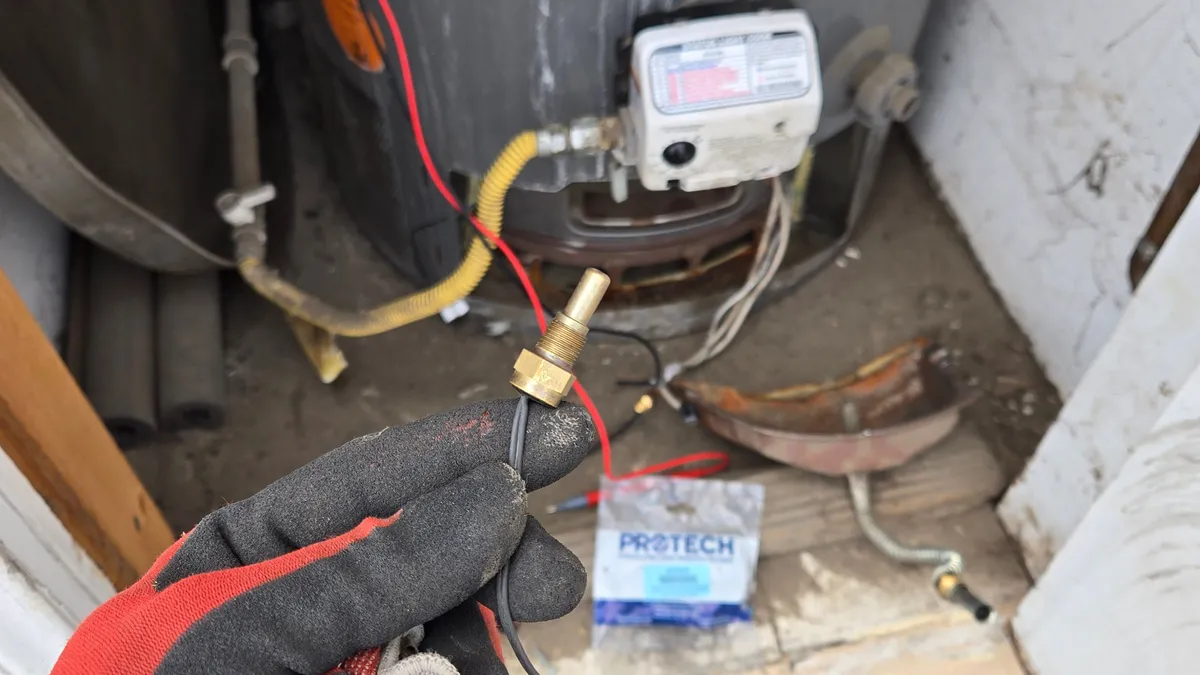
A water heater repair in Sherman Oaks, March 2025. The status light on the gas control valve pointed at a sensor, and the photo shows that sensor in our glove.
In this guide
The call: a gas control valve flashing an error
In March 2025 we worked on a gas water heater in Sherman Oaks. Its gas control valve, the white box low on the tank, was flashing an error code that pointed at a sensor.
The sensor was the chamber sensor. We put a meter on it, and its resistance had drifted. What made it drift, we can’t say for sure. Once a reading moves out of range like that, the gas control stops accepting the sensor, and this one kept flashing the fault.
We replaced the chamber sensor. The new one measured normal resistance, and after that, everything worked.
What does a flashing status light mean on a gas water heater?
A gas control with a status light reports what it finds by blinking. Each pattern stands for one condition, from normal operation to a failed sensor, and the key is a code table printed on the gas control or the heater and repeated in its manual.
The code narrows the search to a circuit or a condition. A loose connector or a damaged wire on that circuit can set off the same code as a failed sensor, so before we replace anything, we check the part itself with a meter. We compare the reading with the manufacturer’s specification, which for a thermistor depends on its temperature.
What is a chamber sensor?
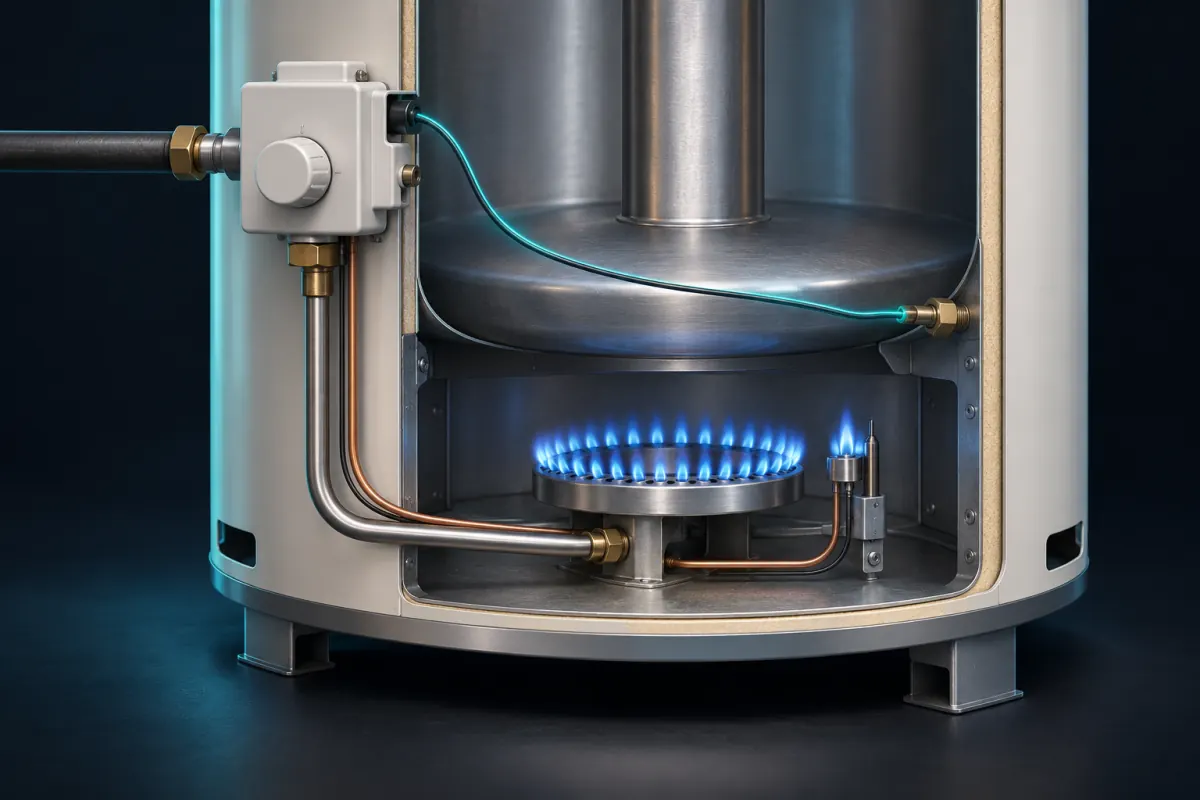
Rheem’s parts division sells the chamber sensor as a replacement kit and describes its job plainly: the sensor monitors combustion chamber temperature and will shut the water heater down to prevent overheating. Rheem lists these kits for its ultra-low-NOx (ULN) self-powered gas water heaters, and each kit pairs a thermistor with a temperature probe.
That ultra-low-NOx design has a local reason. For a natural-gas tank heater like this one, the South Coast air district’s Rule 1121 sets a limit of 10 nanograms of NOx per joule of heat output, and the heater can’t be sold or installed in the district unless it’s certified to that limit.
A thermistor is a resistor whose resistance changes with temperature. The gas control reads that resistance and works out the temperature from it. While the reading stays in the range the control expects, it trusts the sensor. When a sensor fails or drifts out of that range, the control can’t tell whether the combustion chamber is safe, so it shuts down and flashes a code.
“Self-powered” means there’s no plug. The pilot flame heats a thermopile, and the thermopile makes the small voltage the gas control runs on.
What the photo shows
The photo is from this job. In our glove is the chamber sensor: a small threaded brass body on a thin black lead. Behind it you can see the white gas control valve, with a printed label on its face, and the yellow flexible connector that brings gas to it. A red lead from our meter runs down the side of the tank.
A ProTech parts bag lies on the floor. ProTech is Rheem’s replacement-parts brand, which fits our recollection that this heater is a Rheem, though the brand itself can’t be read in the photo.
The heater stands in an exterior closet.
Sensor faults and pilot problems look different
On a standing-pilot water heater, the pilot flame lights the main burner. It also heats a thermocouple or, on self-powered controls, the thermopile. If the pilot goes out or that part weakens, the control loses the signal or the power it needs, and the gas stays off. You’ll usually see a pilot that won’t stay lit or a status light that’s gone dark.
A sensor fault works differently. The pilot can be burning fine and the control can have power, yet it rejects one of its readings. That’s why the code comes first: relighting the pilot won’t fix a sensor the control has rejected, and neither will a new thermopile.
Why replace the sensor and not the gas control or the heater?
The code pointed at one part, and the meter showed that part was out of range. So we replaced that part. A new gas control on a hunch would have cost more, and with the old sensor still in place, the new control would have rejected it too. Replacing the heater over a sensor would mean buying a whole appliance to fix one small part that, on Rheem heaters, comes as its own kit.
Diagnosis runs the other way as well. If a sensor flagged by a code measures normal, its wiring and connections come next, and only then the control. We followed the same logic on a Daikin mini split whose thermistor gave itself away on a meter, and our repair or replace guide covers the bigger decision.
What you can check safely
Start with the light. Count the blinks between pauses and look the pattern up in the code table on the heater or in its manual. Then check the knob on the gas control: if someone turned it to OFF or down to PILOT, the main burner won’t come on. Write down the model and serial number from the rating plate. You’ll need them to find the right manual, and a technician will ask for them.
Keep the base of the heater clear. Rheem’s manual for its gas water heaters tells owners not to block the combustion air openings around the bottom of the jacket, and the heater’s own label warns against storing gasoline or other flammables nearby. If the status light is dark and the pilot is out, follow only the lighting instructions printed on the heater, and stop and call if it won’t stay lit.
Leave the rest to a technician. Don’t open the burner compartment or take off the burner access door, and keep your hands off the gas lines and the gas control. On Rheem heaters, the manual says only a qualified service technician should remove that door, and a new door gasket has to go on whenever it comes off.
If you smell gas
Don’t look for the leak. Leave the house without touching light switches or using a phone inside. Once you’re outside, call 911 or SoCalGas.
Water heater repair in Sherman Oaks
At Epic Star we repair gas, electric and tankless water heaters in Sherman Oaks and across the Westside, Hollywood and the San Fernando Valley. Gas-line work and full tank replacement go to a licensed plumber, and we’ll tell you if your job is one of those. We price the repair after we’ve diagnosed it on site. The $85 service call is credited toward the repair if you go ahead, and repairs carry a 30-day labor and 90-day parts warranty. CA BEAR registered (#A 50636), EPA Section 608 Universal certified, $1M insured. See our water heater repair service or call (213) 205-2055.
FAQ
What does a flashing light on a gas water heater's control valve mean?
The status light blinks in patterns, and each pattern stands for one condition, from normal operation to a fault. You'll find which is which in the code table on the heater or in its manual. On this Sherman Oaks heater, the pattern pointed at the chamber sensor.
What is a chamber sensor on a gas water heater?
It's a temperature sensor at the combustion chamber. Rheem's parts division describes its chamber sensor kits as monitoring combustion chamber temperature and shutting the water heater down to prevent overheating. The kits are listed for Rheem's ultra-low-NOx self-powered heaters, and each one pairs a thermistor with a temperature probe.
How did you know the sensor was bad?
The status light pointed at it, and a meter confirmed it: the old sensor's resistance had drifted, so the gas control no longer accepted it. A new sensor measured normal, and once it was in, everything worked.
Can I replace a water heater chamber sensor myself?
We don't recommend it. Rheem's chamber sensor kits come with a new burner door gasket, and Rheem's manual says only a qualified service technician should take the burner access door off. Note the status light pattern and the model number from the rating plate, then call.
Do you repair gas water heaters in Sherman Oaks?
Yes. We repair gas, electric and tankless water heaters in Sherman Oaks and across the Westside, Hollywood and the San Fernando Valley. The $85 service call is credited toward the repair if you go ahead. Gas-line work and full tank replacement go to a licensed plumber, and we'll tell you if your job is one of those.
Got an appliance that needs fixing? We cover LA and the Valley.
Call (213) 205-2055 or text a photo of your appliance.